
Free tool /07
Your website’s CO₂ impact.
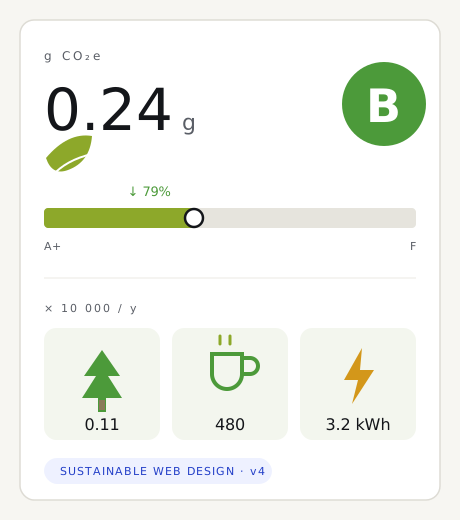
Every website visit consumes energy and produces CO₂. We measure your page weight and estimate emissions per visit and per year, using the Sustainable Web Design model. A lighter website is also a faster one.
How it works
Three steps, no sign-up.
01
Enter the address
The page to measure: usually the homepage, the most visited one.
02
We weigh the page
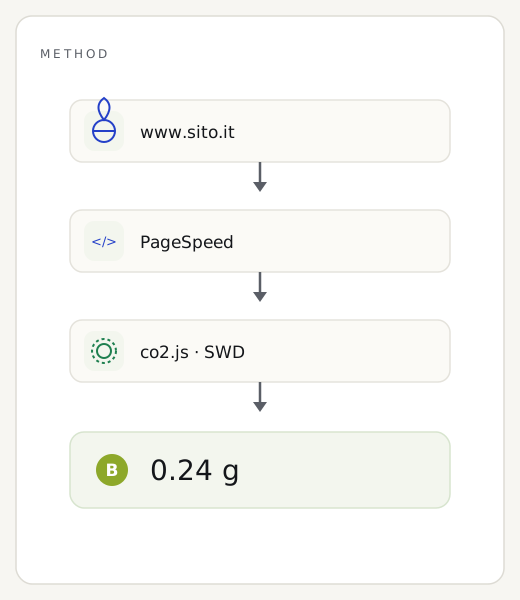
Using the PageSpeed API we measure the total bytes the browser must download to show the page.
03
Emissions estimate
We apply the Sustainable Web Design model (co2.js) and get the grams of CO₂e per visit, a comparison with the web average, and the annual estimate.
The method
How we actually estimate your website’s carbon emissions.
The calculation starts from a concrete, measurable figure: with the PageSpeed API we weigh every byte the browser has to download to show your page. On that weight we apply the Green Web Foundation’s Sustainable Web Design model — the same formulas as the open-source co2.js library — which translates transferred bytes into energy consumed along the chain (data centre, network, device) and finally into grams of CO₂ equivalent per visit.
It’s an estimate, and it’s only fair to treat it as one. The model uses global average coefficients for energy intensity and the electricity mix: it doesn’t know the real energy source of your hosting or the exact behaviour of each visitor. It isn’t a certified measurement of environmental footprint, but a reliable, comparable order of magnitude. Its strength is that it ties back to a technical fact — page weight — that you can genuinely act on.
Reading the result
How to read your website’s CO₂ grams per visit.
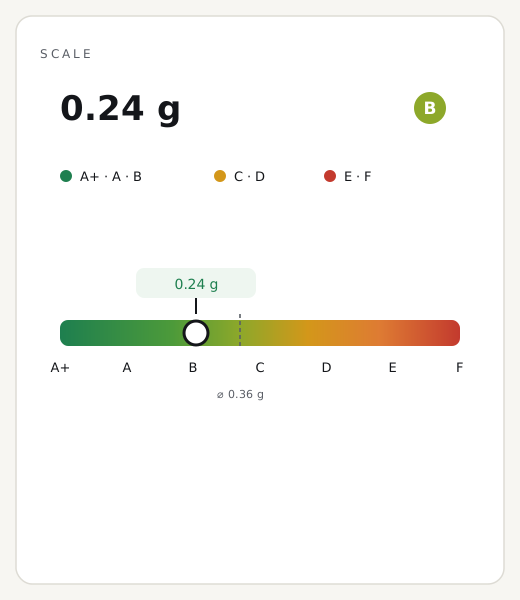
The key number is the CO₂ equivalent per single visit, which we compare against the web average, around 0.36 grams. Below that threshold you’re among the lighter sites; noticeably above it, your page is heavier than average and there’s room to lighten it. The annual estimate multiplies that value by a reference traffic figure: change it to your site’s real visits, and the impact grows or shrinks proportionally.
The comparison matters more than the absolute value. A few grams per visit look like nothing, but multiplied by tens of thousands of visits a month they become a real figure — and above all, they mirror a heavy page: the sites that pollute more are almost always the ones that load more slowly, too. So read the impact as a second performance indicator, not only as an environmental issue.
Your result, on display
Show it off: the CO₂ badge for your site.
If your site is among the lighter ones, say so. The CO₂ badge shows grams per visit and how you compare to other tested sites — verifiable proof of care, not a vague claim. It’s the badge category with the longest track record on the web: visitors already know what it means to see one in a footer.
<a href="https://remarka.biz/en/tools/website-carbon/" target="_blank" rel="noopener">
  <img src="https://remarka.biz/wp-admin/admin-ajax.php?action=remarka_badge&t=co2&gr=0.19&d=2026-07&th=dark&l=en"
       alt="0.19g of CO₂ per visit — verified by Remarka" width="160" height="59" loading="lazy">
</a>
Swap gr=0.19 for your own result after the test — full guide and other badges →
Three common questions
How do you calculate emissions?
With the Green Web Foundation’s Sustainable Web Design model (the co2.js library, Apache-2.0): from page weight to energy consumed, down to grams of CO₂e. It’s an estimate using global average coefficients.
Why does a lighter website pollute less?
Because every byte transferred consumes energy — in the data center, on the network, on your device. Less weight means less energy, fewer emissions and, as a side effect, a faster website.
Where does the annual estimate come from?
We multiply the per-visit emissions by a reference traffic of 10,000 visits a month. Change it to your website’s real traffic and the estimate scales proportionally.
How to improve
How to reduce your website’s carbon footprint.
Cutting emissions and speeding up your site are the same job: both come down to trimming unnecessary weight.
01
Lighten your images
Photos are almost always the heaviest line item: convert them to WebP or AVIF with lazy loading, and you’ll cut most of the bytes — and the emissions — right there.
02
Cut down scripts and fonts
Every extra third-party library and every additional typeface is energy transferred on every visit: keep only what you truly need.
03
Make the most of caching and a CDN
Good caching and a content delivery network avoid transferring the same content a thousand times over: less repeated traffic, less consumption.
04
Choose green hosting
A provider running on renewable energy lowers the carbon intensity of every byte served: it’s the simplest lever for an immediate effect.
05
Favour a sober design
No autoplaying video or heavy animation where it isn’t needed: a clean aesthetic consumes less and, often, communicates better.
Want to lighten up the website?
Optimized images, a clean technical foundation, less weight for the same content: less CO₂ and PageSpeed 90+ by contract.
The other free tools