Strumento gratuito /09
Your website, read by AI.
Paste your address: an artificial intelligence reads your homepage the way ChatGPT or an AI assistant would, and tells you what it understood. What you do, who for, and how easy it is — for an AI — to cite you in an answer. In under a minute, a verdict and the three moves that matter. This isn’t the technical check from «Ready for AI»: here the AI actually reads you.

How it works
Three steps, no sign-up.
01
Paste in the address
Your homepage or the page that represents you. No sign-up, no payment details.
02
The AI reads like an assistant
Our server takes the text, headings, structured data, llms.txt and robots.txt of the page and passes them to an AI model — the same information an AI assistant sees when it comes across you.
03
See what it understood
What you do and who for, according to the AI; a «citability» score from 0 to 100; and three concrete moves, in the form «do X → get Y». We send you the rest of the analysis by e-mail.
The method
What the AI sees when it reads your site.
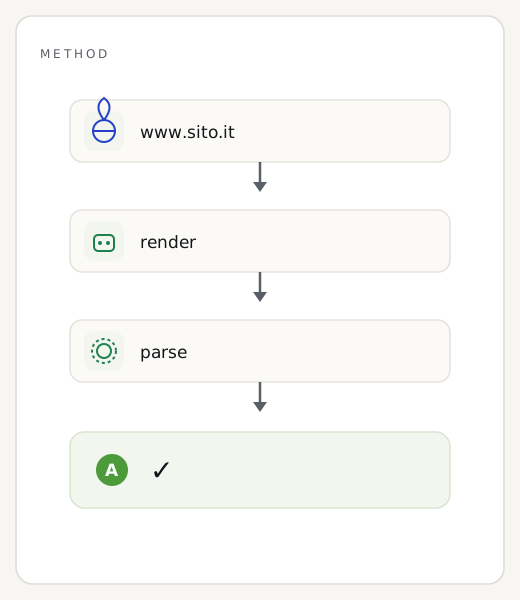
An AI assistant doesn’t «look at» a site the way a visitor does: it reads the text, the headings, the meta description, the structured data and — if there are any — the llms.txt and the rules for its crawlers. From those signals it reconstructs who you are and what you offer. We pass a model exactly that material and ask it three simple things: what this site does, who it’s for, and how confident it would be citing it in an answer. That’s where the citability score comes from: it isn’t your ranking on ChatGPT, it’s how well your site explains itself.
It’s only fair to say what this tool doesn’t do. It doesn’t promise ChatGPT will name you, it doesn’t count how many times you’re already cited, it isn’t a page-by-page technical audit. It’s a qualitative reading: a mirror of how a machine interprets your words. If the AI misunderstands, it’s usually the site that isn’t speaking clearly — and that’s something you can fix.
Reading the result
How to read the verdict and the citability score.
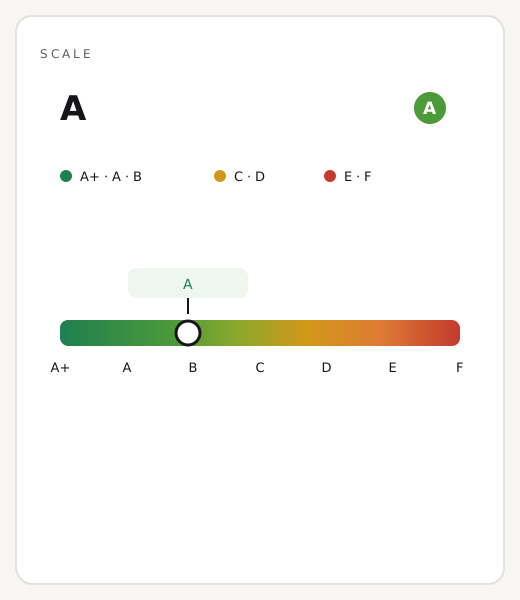
Start with the verdict and the three moves: they’re already ranked by impact and written as actions, «do this → that happens». Then look at the citability score. From 75 up, the AI understands you and would gladly cite you: the site presents itself well. Between 50 and 74, the sense is there but something is confusing — a generic title, a homepage that doesn’t say straight away what you sell. Below 50, the AI struggles to say what you do: that’s the first thing to fix, before any tactic.
Two readings to avoid. A high score doesn’t mean «first on ChatGPT»: it means you explain yourselves well, which is the precondition, not the guarantee. And if «what it understood» doesn’t sound like you, that isn’t the AI’s mistake: it’s a sign that your site, read from the outside, tells a different story from the one in your head.
Three common questions
Is this the same as «Is your site ready for AI?»
No, they’re complementary. «Ready for AI» checks the technical signals — llms.txt, crawler access, structured data, sitemap — and gives a score out of 4. Here the AI actually reads your content and tells you what it understood. One measures the gears, the other the result.
Do you store my site’s text?
No. The page content is read once to generate the analysis and we don’t save it. We only cache the result, for 24 hours, so a second run on the same site is instant.
Why does the full analysis arrive by e-mail?
On screen you get the verdict and the three moves right away. We send you the rest — what the AI understood, who it thinks you’re for, why that score — by e-mail, so it stays handy when you talk about it with us or your team.
Want the AI to understand you on the first try?
From verdict to work: we make your site readable by AI assistants and search engines — clear content, structured data, llms.txt. At a fixed price, with PageSpeed 90+ guaranteed by contract.
The other free tools