
15 JUL 2026
EAA 2026: what your e-commerce site really risks
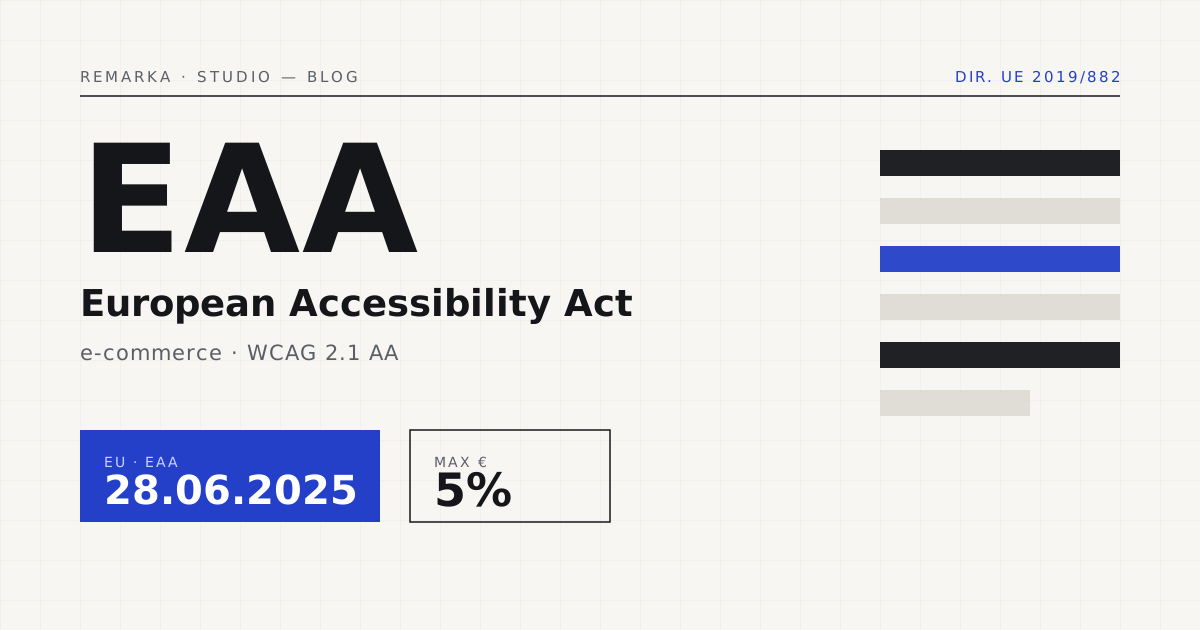
28 June 2025 came and went quietly, and that’s exactly why it does more damage. Since that date the European Accessibility Act has been enforced law in Italy too, and it affects far more e-commerce sites than have noticed: if you sell online to consumers, your store most likely has to be usable by people with disabilities as well — not as a courtesy, but by law, with fines the Italian transposition sets at up to 5% of revenue. No panic, and no pretending it isn’t happening: let’s look at what your e-commerce site really risks, who’s left out, and what’s worth doing now.
What the European Accessibility Act is, in plain terms.
The European Accessibility Act (EAA) comes from EU Directive 2019/882, and the idea is almost obvious once you say it out loud. A physical shop with three steps at the door and no ramp shuts out some of its customers; an e-commerce site with unreadable contrast, images without descriptions and a checkout you can’t complete from the keyboard does exactly the same thing — you just can’t see it. The law requires that digital services sold to consumers be usable by people with a visual, motor or cognitive disability too.
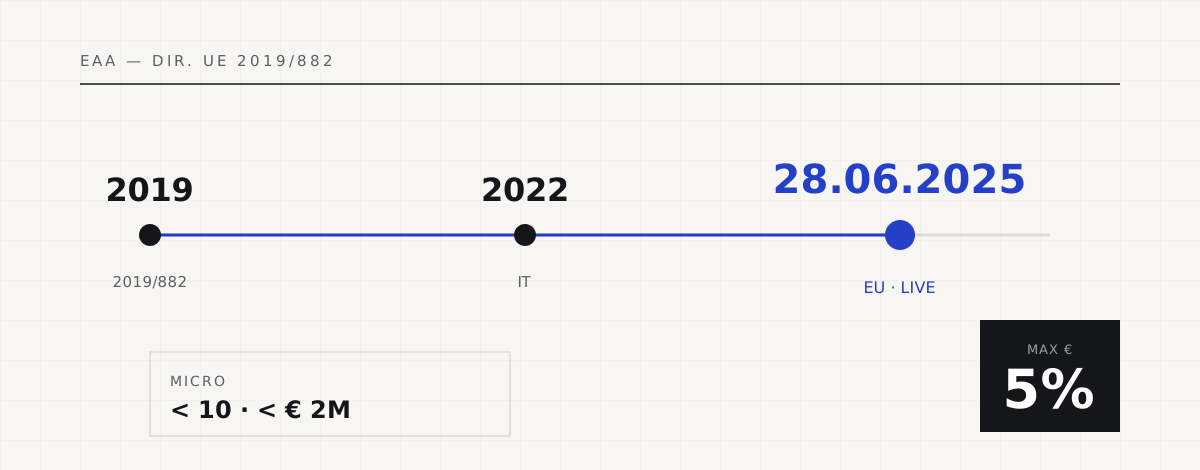
In Italy the directive has been transposed and applies from 28 June 2025. The reference standard isn’t a matter of opinion: it’s WCAG 2.1 level AA, the same international guidelines developers have used for years. This isn’t a fad that started yesterday — it’s a path that began in 2019 and has just reached its deadline.
Directive (EU) 2019/882, the official text on EUR-Lex →
What your e-commerce site really risks under the European Accessibility Act.
Let’s start with the money, because that’s the real question. The Italian transposition provides for fines of up to 5% of revenue for non-compliant services: for a store turning over € 800,000 a year that’s up to € 40,000 — more than rebuilding the site from scratch would cost. This isn’t a theoretical risk. In France, where enforcement started earlier, the first cases against large online retailers have already landed; in Italy oversight has only just begun, and the first complaints are a matter of months, not years.
But the fine is the part that scares you most, not the part that costs you most. An inaccessible e-commerce site loses customers every day, quietly, long before any inspection. Think of the person who sees poorly and can’t read an elegant light gray, the one browsing one-handed on a phone, the one filling in the order from the keyboard because the mouse is awkward for them: every barrier is an abandoned cart that will never show up in your reports as an “accessibility problem.” You’ll read it as a “low conversion rate,” and you’ll blame the price.
Are you covered? The micro-enterprise rule.
Everyone asks us the same thing: “does this apply to me too?” The honest answer is “almost always yes, but check.” The law looks at anyone selling goods or services to consumers at a distance. There is, however, an exemption for service micro-enterprises — fewer than 10 people and under € 2 million in annual revenue. The exemption is built for services, and the exact scope has to be looked at case by case, not by gut feeling: when in doubt, a half-hour check beats a fine.
Check your site’s barriers for free →
Where to start: the four words that matter.
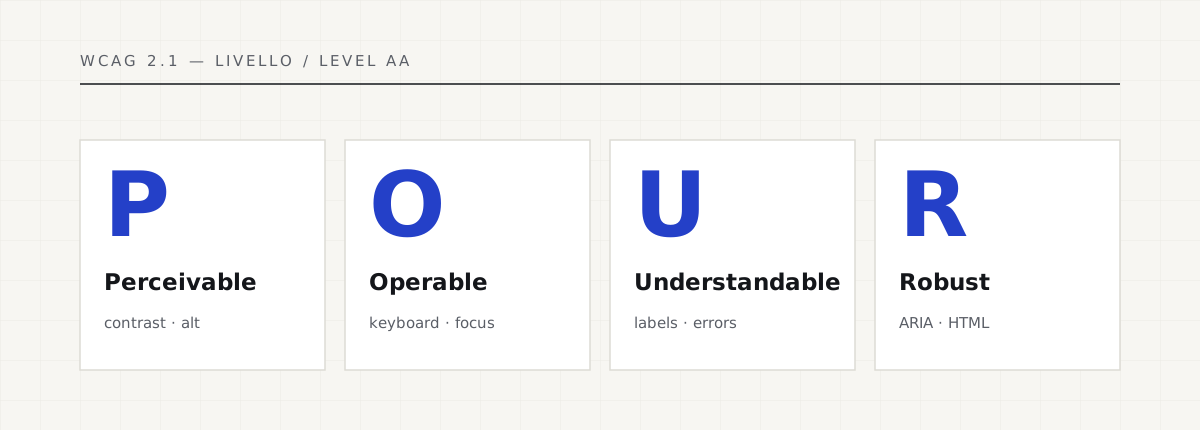
WCAG 2.1 AA looks like a wall of acronyms, but it rests on four simple principles, summed up as POUR: an accessible site is perceivable, operable, understandable and robust. In practice: text you can read even with poor eyesight, everything reachable from the keyboard, forms with clear labels and error messages that explain what to do, and clean code that screen readers can read.
Three weeks, from audit to statement.
A free automated check is the first step: in a minute it tells you whether the site already has the most obvious problems — contrast, labels, structure. But full compliance isn’t certified by a score: it takes a manual review (keyboard, screen reader, content) and an accessibility statement published on the site, the document the law requires. Without the statement, a technically accessible site is still not compliant.
The good news is that it isn’t an endless job. For a mid-sized e-commerce site, from audit to fixes to statement it’s usually three weeks. Taken in time, the obligation isn’t money down the drain: it’s a site that sells to more people and doesn’t fear the first enforcement letter.
Want us to fix it? The EAA compliance service, at a fixed price →
WCAG 2.1 AA, the official W3C criteria →
Sources.
The figures and claims in this article come from here. These are primary sources, not summaries: open them and check for yourself.
- Directive (EU) 2019/882 (EUR-Lex)The official text of the European Accessibility Act: this is where the obligation comes from.
- AccessibleEU — European CommissionThe EU accessibility competence center confirms the entry into force on 28 June 2025.
- WCAG 2.1 — W3CThe reference technical standard (level AA): the criteria by which compliance is measured.
- EAA guide for online commerce — Bird & BirdAn international law firm explains the scope, exemptions, and penalties for those selling online.
Let’s talk about your website.
Free analysis of your current website; a fixed quote within 24 hours of the call.