
17 JUL 2026
Custom management software vs Excel: when the leap pays off
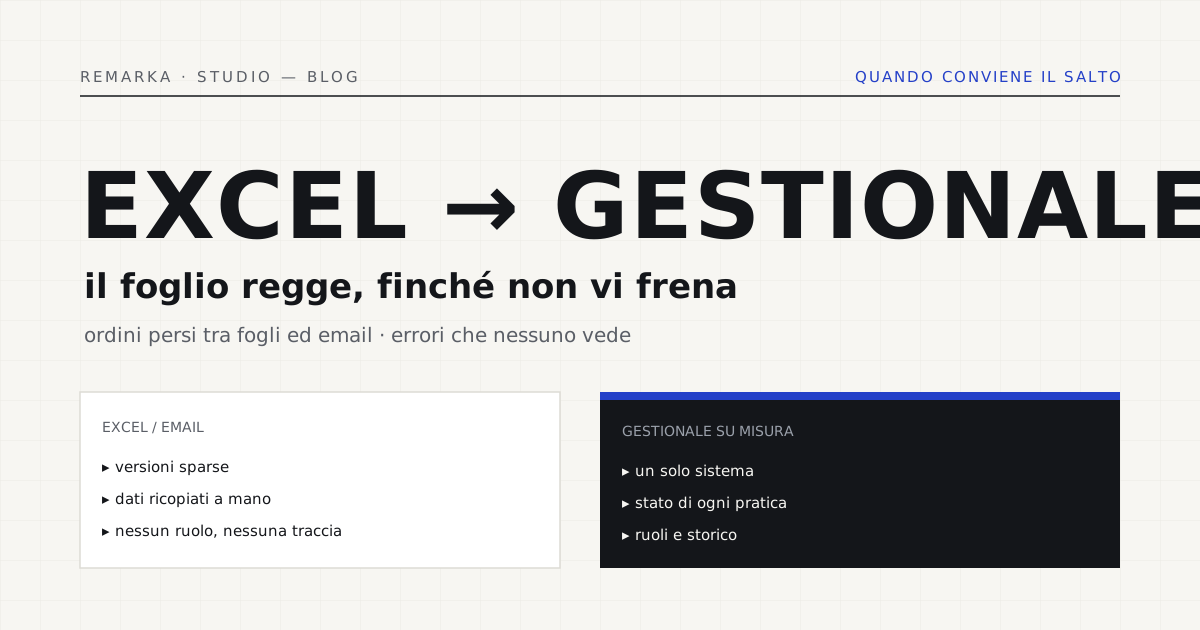
“We get by with Excel.” True, up to a point. The spreadsheet is brilliant while the business is small: it costs nothing, everyone knows how to use it, it bends to any need. Then the number of orders, of clients, of people touching the same file grows — and what was a convenience becomes a bottleneck: the right version that can’t be found, the row overwritten by mistake, the order vanished between a sheet and an email. At that point the question is no longer “Excel or not,” but when it pays to move to custom management software. In this article we try to answer honestly — and with a real case from the Remarka group, numbers included.
Why Excel holds up — until it holds you back.
The spreadsheet isn’t the enemy: it’s the right starting point for almost everyone. A business handling twenty orders a month doesn’t need a system, it needs a table — and Excel, or a shared sheet, does it perfectly. The problem isn’t the tool, it’s the threshold past which the tool stops helping and starts slowing you down. That threshold almost always arrives with three signs: more people working on the same file, the data growing large, and the same information having to be copied from one sheet to another.
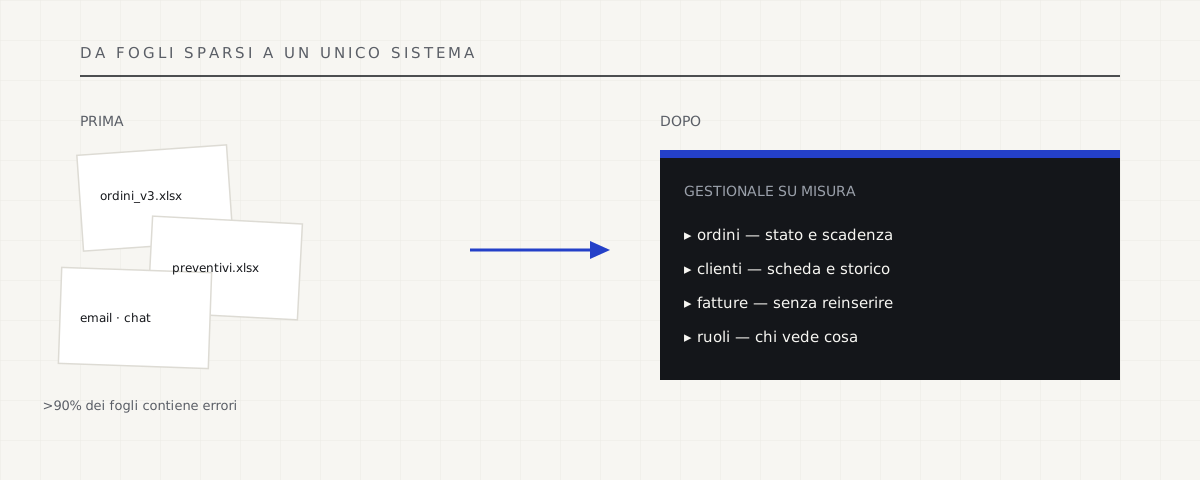
And this is where the silent risk begins. The European research group that studies spreadsheet risks — EuSpRIG — estimates that over 90% of spreadsheets used in business contain errors, and that around half of those used operationally have real defects. Not because whoever fills them in is careless, but because a spreadsheet doesn’t warn you when a formula breaks or a row is overwritten: the error stays there, invisible, until it costs something.
The hidden costs of spreadsheets.
Excel’s price isn’t in the licence, it’s in time and errors. Take the most common symptoms, the ones every company grown on spreadsheets recognises at a glance.
When the leap to custom management software pays off.
None of these problems is dramatic on its own. Together, though, they form a daily tax on the team’s time — and every so often an error that ends up on an invoice or in a missed delivery. The records collected by EuSpRIG are full of cases where a single spreadsheet mistake cost restated accounts and wrong numbers taken as true. The right moment for the leap isn’t a size, it’s a set of symptoms: if you recognise three or more, the spreadsheet has finished helping you.
A real case: the system that runs an agency.
Careful: “custom management software” doesn’t necessarily mean a huge project. It means a system built around your way of working, instead of bending the work to off-the-shelf software that does 70% of what you need and forces you to do the remaining 30% by hand. Here too we’re talking about what we built for ourselves. Running hundreds of translation orders — clients, translators, deadlines, quotes, invoices — on sheets and email had become the bottleneck that broke deliveries.
So the Remarka group built a TMS, custom management software where every order has a status, every client a record, every translator a workload, and every job its invoice: order board, contacts, quotes and accounting in a single web app. The numbers, real: the system has been in production for two years and handles 180 orders a month, over 2,000 a year. Inside it work 2 administrators, 8 project managers and 4 partner agencies with their own client base — and orders no longer get lost in email. It’s the same engineering we put into custom web software for your company.
The full case, with a link to the live project →
A custom management web app for you →
Before deciding: two questions and one number.
You don’t need to redo everything tomorrow. Before talking about a management system, ask yourselves two honest questions: how many hours a week does the team spend fixing, searching and re-copying data between sheets and email? And how many times, in the past year, has an error or a lost piece of information cost you a client, a delivery or an embarrassment? If the answers make you uncomfortable, the bill for Excel’s “free” is steeper than it looks.
The next step is to map the real flow — how an order is born, who touches it, where it gets stuck — and work out which steps a custom system can remove. Out of that comes a project with a fixed price, not a leap in the dark. And if your work already lives inside chats, it’s worth knowing that management system can go inside Telegram too, in the team’s pocket.
We design your custom management software, at a fixed price →
Measure the technical health of your current site →
Read also: the Telegram Mini App, the management system in your pocket →
Sources.
The figures and claims in this article come from here. These are primary sources, not summaries: open them and check for yourself.
- EuSpRIG — research on spreadsheet risksThe European group that studies spreadsheet errors: over 90% contain them, half of those used operationally have defects.
- EuSpRIG — the spreadsheet “horror stories”Real cases where an Excel error cost wrong accounts and decisions made on false numbers.
- Regulation (EU) 2016/679 — GDPR (EUR-Lex)Managing client data scattered across sheets and email is also a data-protection risk: a system with roles reduces it.
We design your custom management software, at a fixed price →
Let’s talk about your website.
Free analysis of your current website; a fixed quote within 24 hours of the call.