
Case studies / Web app · Telegram Mini App
What goes under the plaster stays on record.
Hometr («Хоуметр» in Russian) is a new platform for apartment renovation in Russia. The client needed one thing done right: wiring and pipes photographed with their position on the wall before they vanish under the plaster. Those photos build the apartment’s digital passport, which stays with the owner. We built the website, the API and a Telegram Mini App that keeps working on a site with no signal — between 2 and 16 September 2026.
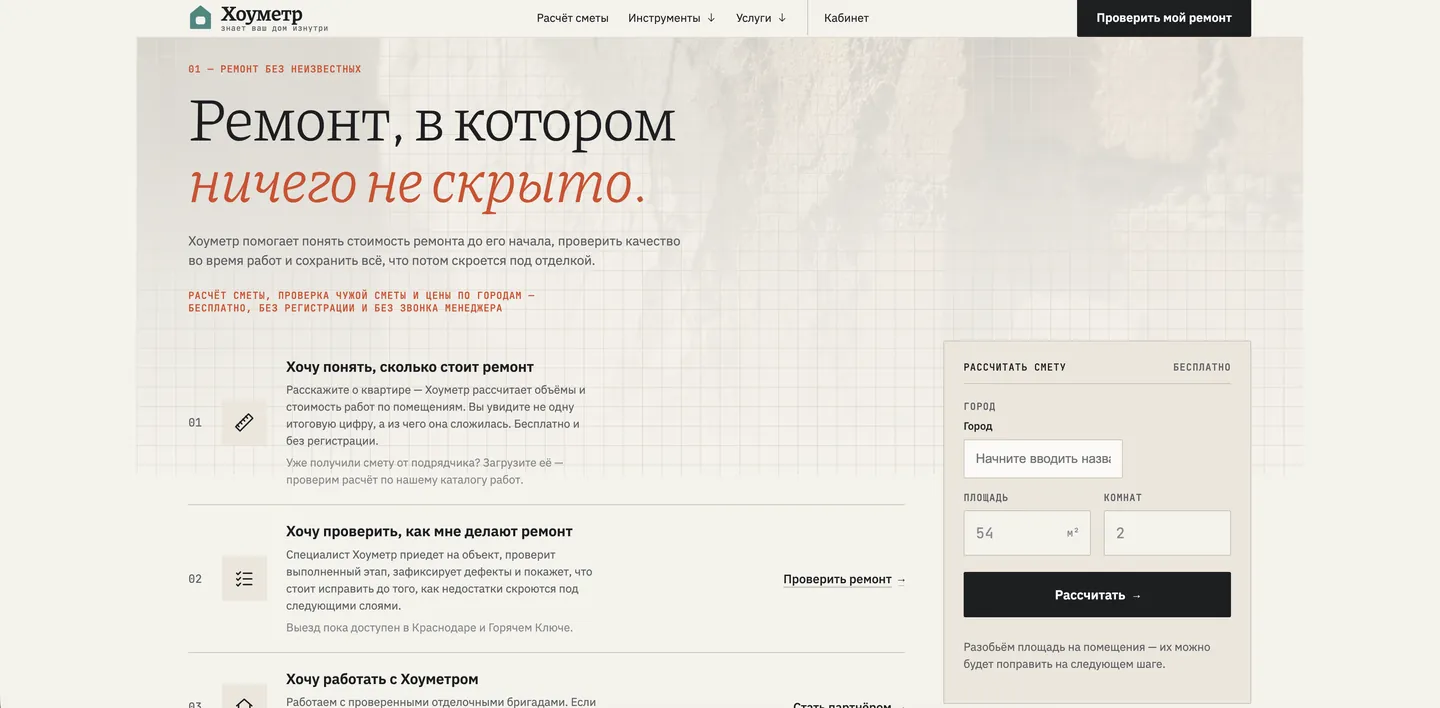
The problem
Once the plaster is on, nobody knows where the cables run.
In a renovation, the work that matters most is the work nobody sees afterwards: wiring and pipes disappear under plaster and tiles. From then on, their position lives in the crew’s memory — for as long as the crew remembers.
Three kinds of people need that information, each for a different reason: the owner, who will one day drill into a wall; the foreman or craftsman, who has to be able to show the job was done properly; and the buyer of a second-hand flat, who wants to know what’s behind the walls.
Our answer
A photo for every surface, before it’s closed up.
The client wanted a tool that turns that memory into a record. We built a platform where hidden works are photographed with their position on the wall, stage by stage. Those photos make up the apartment’s digital passport, which belongs to the owner — not to the contractor. The interface is in Russian; for now, renovation crews work only in Krasnodar and Goryachy Klyuch.
On site · Telegram Mini App
Four corners on a photo, and the wall becomes a map in millimetres.
A renovation site runs on phones, so the day-to-day work goes through a Telegram Mini App (m.hometr.ru) that opens inside the chat — nothing to install. The worker photographs the open wall and marks its four corners on the photo; the system straightens the perspective — a calculation called a homography — and converts positions into millimetres. We didn’t trust it by eye: an automated test requires the error to stay within 2% of the wall’s size, even with ±0.5 px of noise on each tap.
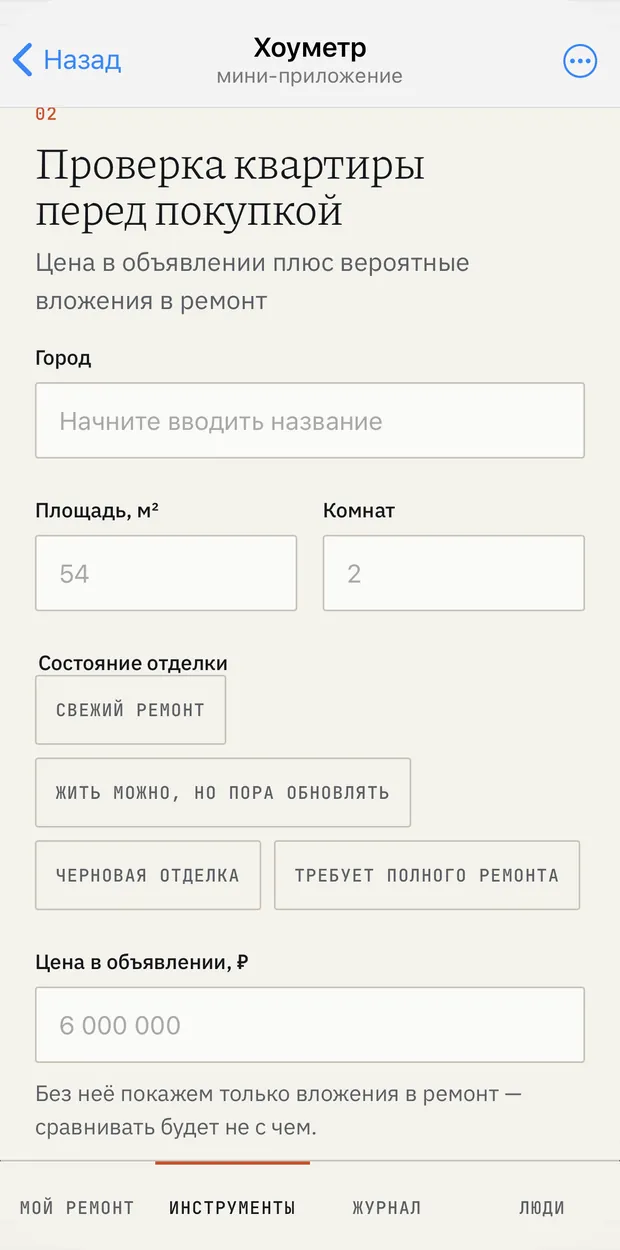
In the screenshot: the Tools tab, checking a flat before you buy it — the listing price plus the likely cost of renovation. At the bottom, all four tabs: My renovation, Tools, Log, People.
On the website · free tools
Upload an estimate, see the suspicious lines.
Not everyone arrives with a renovation already under way: sometimes there’s only a contractor’s estimate and a doubt. For that moment the site offers a free check. You upload the estimate — XLSX, CSV or a PDF with a text layer — and every line is matched against a catalogue of 97 work items in 6 groups. The matching is fuzzy, so it recognises the same job even when it’s worded differently; then a set of rules flags the suspicious lines.
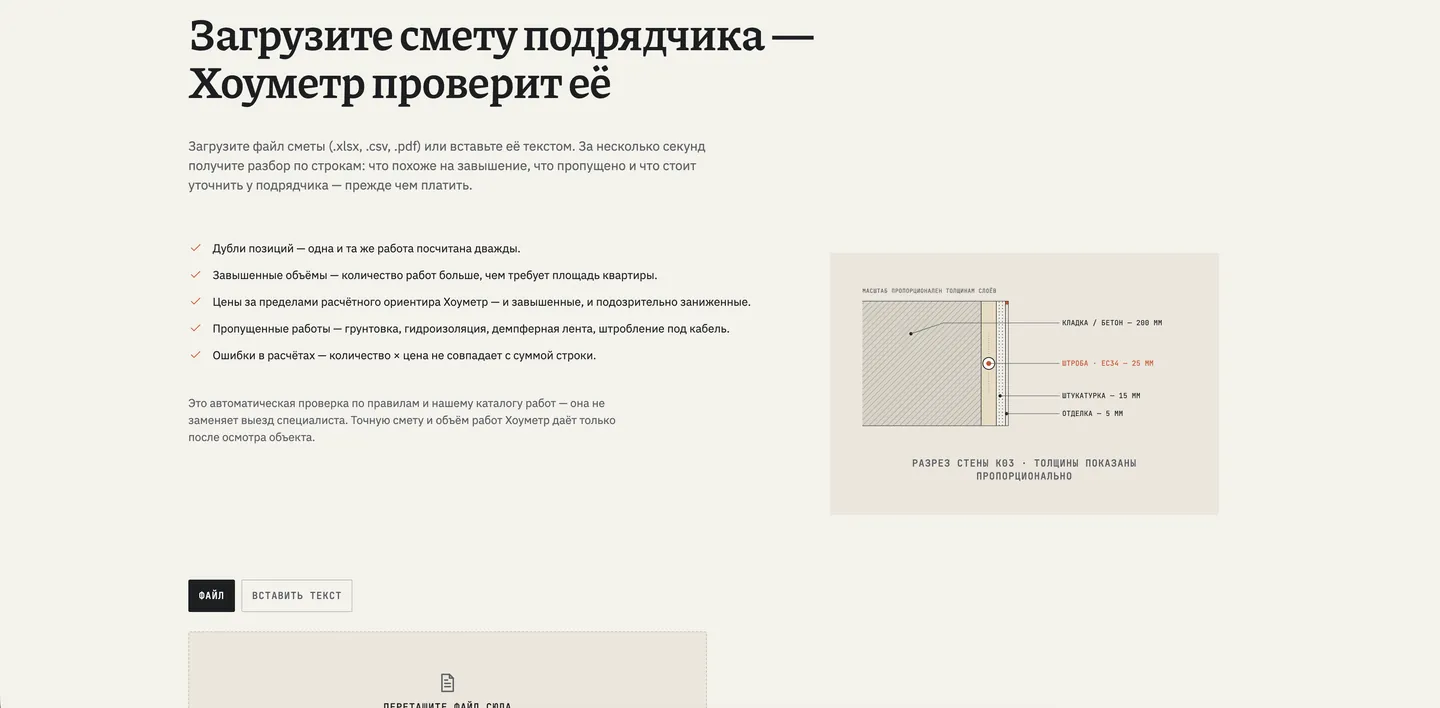
What the check looks for: duplicate lines, inflated quantities, prices outside the benchmark, missing work and calculation errors. And an honest caveat on the page itself: an automatic check does not replace a specialist’s site visit.
Three free tools on the website:
Accepted formats
The passport · privacy by design
The passport belongs to the owner. The address never leaves.
The digital passport doesn’t sit in the contractor’s drawer: it belongs to the owner, who can share it through a public link — with someone about to buy the flat, for example. That link (/p/…) never shows the address, and it can be revoked. When paperwork is needed, there’s a PDF act of hidden works and a ZIP export of the whole property.
Photos of the inside of a home, tied to an address, are sensitive data. So privacy went into the design from the start, rather than being bolted on at the end.
How it’s built
Three front doors, one engine.
To the people using it, Hometr is three things: the website, the Mini App inside Telegram and the bot that answers in chat. Behind them is one engine — a Python API all three rely on — so the rules, like the stage that won’t close without photos, live in one place. Everything runs in Docker containers, and the codebase holds over 2,000 automated tests. It’s the same set-up we’d propose for a custom web app of yours.
The result
A new platform, built on evidence rather than promises.
of development, from 2 to 16 September 2026: website, API and Mini App
of work in 6 groups: the catalogue the free estimate check matches against
error allowed by the automated wall-map test, with ±0.5 px of noise on each tap
BUILT BY STUDIO REMARKA FOR THE CLIENT — VERIFIABLE AT hometr.ru
Interested in this project?
Need a custom website or app? Let’s talk.
We design and build custom websites and web apps for companies and professionals. Tell us your idea: we’ll reply with an analysis or a fixed quote.
- Fixed quote within 24 hours
- Clear price, no surprises
- Your data stays in the EU
REQUEST SENT ✓
Thank you. We reply within one business day.