
16 JUL 2026
How much your site weighs on the environment (and on your wallet)
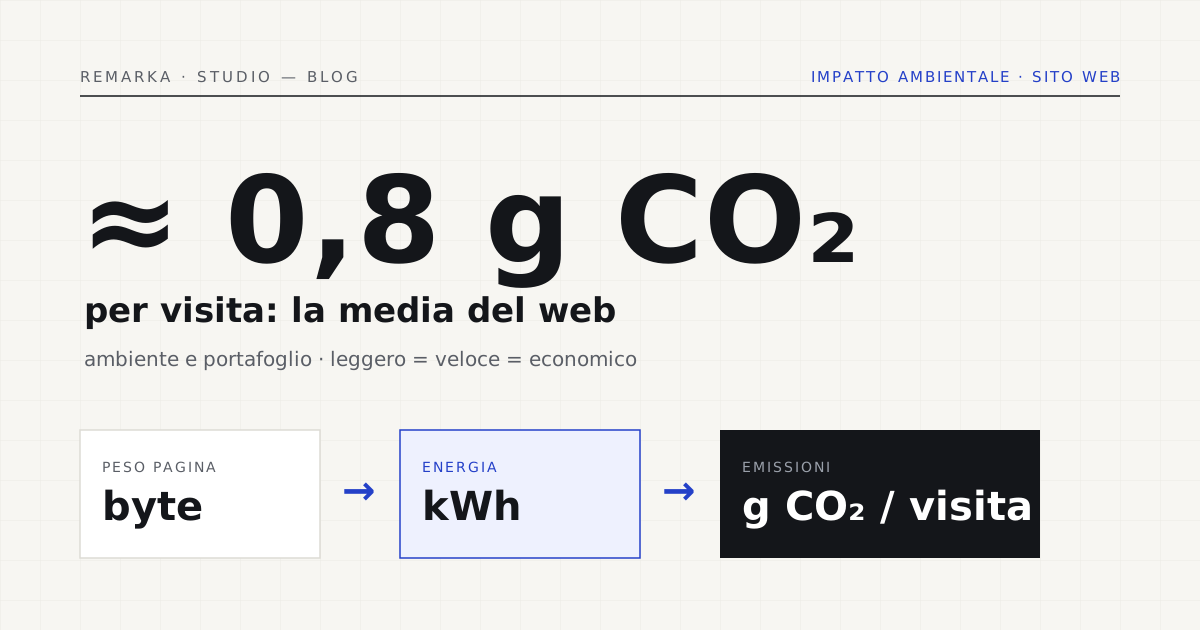
A website seems immaterial, but it isn’t: every time someone opens it, bytes travel from a data center to their screen, and that journey consumes energy. Multiply by tens of thousands of visits a month and the “immaterial” becomes a bill and a bit of carbon dioxide. The good news is that a website’s environmental impact can be estimated, and that reducing it almost always coincides with making it faster and cheaper. Let’s see how it’s measured, what it has to do with your accounts and the new European reporting rules, and what you can do in an afternoon.
A site has a weight, and the weight has a cost.
A page’s weight is the sum of everything the browser has to download to show it: images, fonts, scripts, video. The heavier it is, the more energy it takes to transfer and display — in the data center, along the network, on the viewer’s device. That energy has two parallel prices: an environmental one, in grams of CO₂, and an economic one, in more expensive servers, campaigns that bring visits that flee, and customers who leave before seeing the first line because the phone is struggling.
That’s why we talk about the environment and the wallet in the same breath: they aren’t two conversations, it’s the same conversation. The page that pollutes most is, almost always, the same one that loads more slowly and costs more to maintain.
How to estimate a website’s environmental impact.
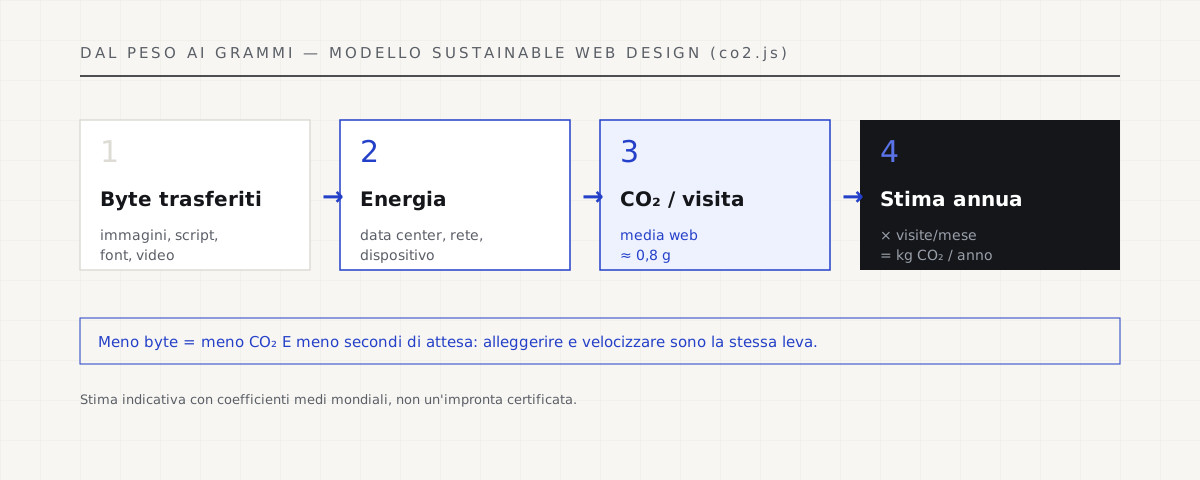
It isn’t a feeling, it’s a calculation. You start from a measurable figure — the page weight in bytes — and apply a model that turns the transferred bytes into energy and then into grams of CO₂ equivalent. The most widely used model is Sustainable Web Design, made available by the Green Web Foundation in the open-source library co2.js: the same tools behind the web’s emission calculators. The handy reference is the average: a web page produces around 0.8 grams of CO₂ per visit. Below that threshold you’re light; noticeably above, there’s room to lighten.
Some honesty about the limits is in order, because it’s easy to sell smoke here. It’s an estimate with global average coefficients: it doesn’t know your hosting’s real energy or every visitor’s behavior. It isn’t a certified footprint, it’s a reliable, comparable order of magnitude — and its merit is precisely that it hangs on a technical fact you can actually act on: weight.
Why light means fast and cheaper.
Lightening a page and speeding it up are the same operation seen from two sides. Every byte removed is less energy transferred — so less CO₂ — and at the same time less loading time, so more visits that stay. Unoptimized photos are almost always the heaviest item: converting them to modern formats can cut them by 80% at the same visible quality, and with them cuts emissions, bandwidth costs and seconds of waiting. You don’t have to choose between doing right by the planet and doing right by the accounts: it’s the same lever.
A typical example from an audit: a homepage of 6 megabytes, almost all in uncompressed photos, brought down to just over 1 megabyte without removing a single image — just modern formats and lazy loading. The result is threefold: a page several seconds faster on a phone, bandwidth saved every month, and a CO₂ footprint per visit more than halved. One intervention, three benefits — environment, speed and cost — that always pull in the same direction.
CO₂ enters the balance sheets too: the CSRD.
Until yesterday a site’s environmental impact was a matter of sensibility. Recently it’s also an item that can end up in a balance sheet. The European directive on sustainability reporting — the CSRD — greatly widens the pool of companies that must report their environmental impacts, and those under the obligation extend it to their suppliers. If you work with or inside companies subject to the CSRD, a measurable, light site stops being a nicety and becomes a figure someone will ask you for. Better to get there with a number in hand than with a shrug.
Let’s say it honestly, as always: our tool gives an indicative estimate, not a certified audit for official reporting. But it’s the right first step — it tells you where you are and how much room you have, even before you talk to a consultant.
The CSRD directive on sustainability reporting (EUR-Lex) →
What you can do in an afternoon.
You don’t have to redo everything to see the number drop. The first moves are simple and pay off right away.
Measure your site’s CO₂ footprint for free →
Vogliamo alleggerirlo noi: restyling e migrazione →
Read also: a slow site, the 7 real causes (and what it costs to fix them) →
Sources.
The figures and claims in this article come from here. These are primary sources, not summaries: open them and check for yourself.
- Sustainable Web Design — emissions estimateThe model used to calculate the CO₂ footprint from the page’s real weight.
- Green Web Foundation — CO2.jsThe open-source library that turns transferred bytes into grams of CO₂ equivalent.
- Direttiva (UE) 2022/2464 — CSRD (EUR-Lex)The official text of the sustainability reporting rules that extend environmental obligations to businesses.
- HTTP Archive — Web Almanac 2024Real data on page weights: where the web’s consumption really concentrates.
- web.dev — Web VitalsWhy a light site is also a fast one: the metrics that link weight, speed and experience.
Let’s talk about your website.
Free analysis of your current website; a fixed quote within 24 hours of the call.