
17 JUL 2026
Telegram Mini Apps for business: the channel Italy is ignoring
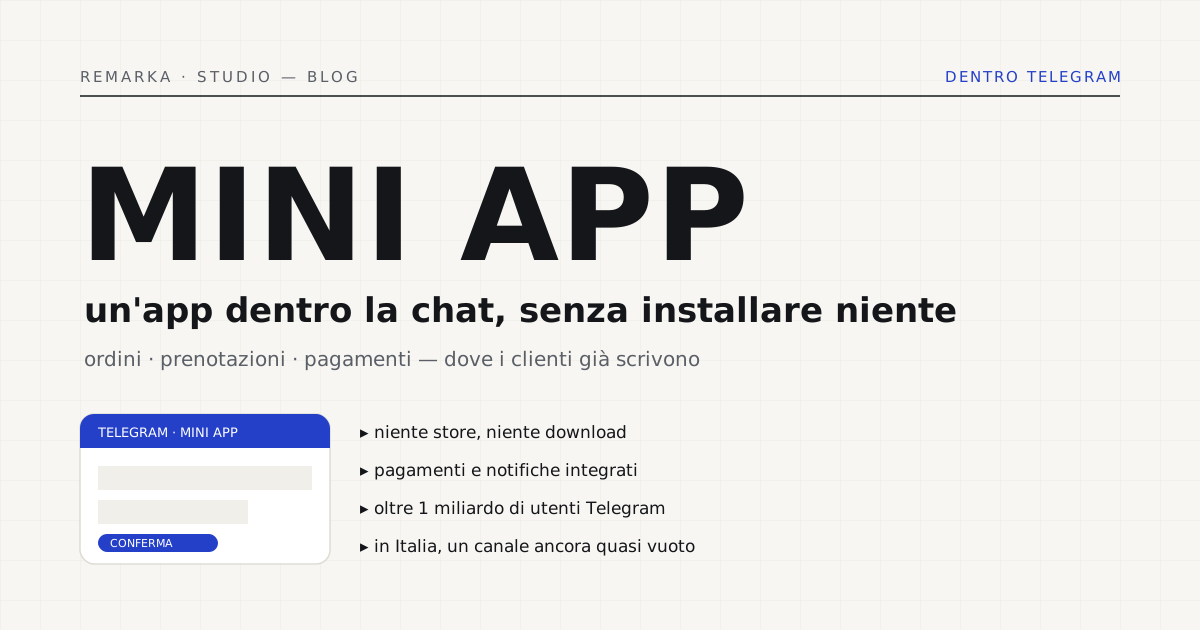
A customer messages you on Telegram to book, like every week. This time, though, instead of the usual four messages to settle on a time, they tap a button inside the chat: a small screen opens, they pick the day, confirm, and they’re done — without leaving Telegram, without installing any app. That screen is a Telegram Mini App, and for a business it’s a channel almost nobody in Italy uses yet. Let’s see what it is, when it really pays off for your business, and why the Remarka group built one for its own work — with real numbers, not promises.
What a Telegram Mini App is (and what it isn’t).
A Telegram Mini App is, in one line, a web app that opens inside Telegram. Technically it’s a website — made of the same things as any site, pages and code — that Telegram shows full-screen inside the chat when the user taps a button. There’s nothing to download from a store, it takes no memory, it asks for no updates: it lives one tap away from the conversation. Telegram’s official documentation describes it exactly this way, as a web interface that can completely replace a website, but inside the messaging app.
It helps to tell it apart from two things it resembles. A Telegram bot replies to commands and text messages: useful, but it stays a question-and-answer conversation. A native app, the kind from the store, is powerful but expensive, has to be downloaded and maintained twice for iOS and Android. The Mini App sits in the middle and takes the best of both: the rich interface of an app, but inside Telegram and with nothing to install. It’s the right place when the interaction has to be more than a message, yet doesn’t deserve an app to download.
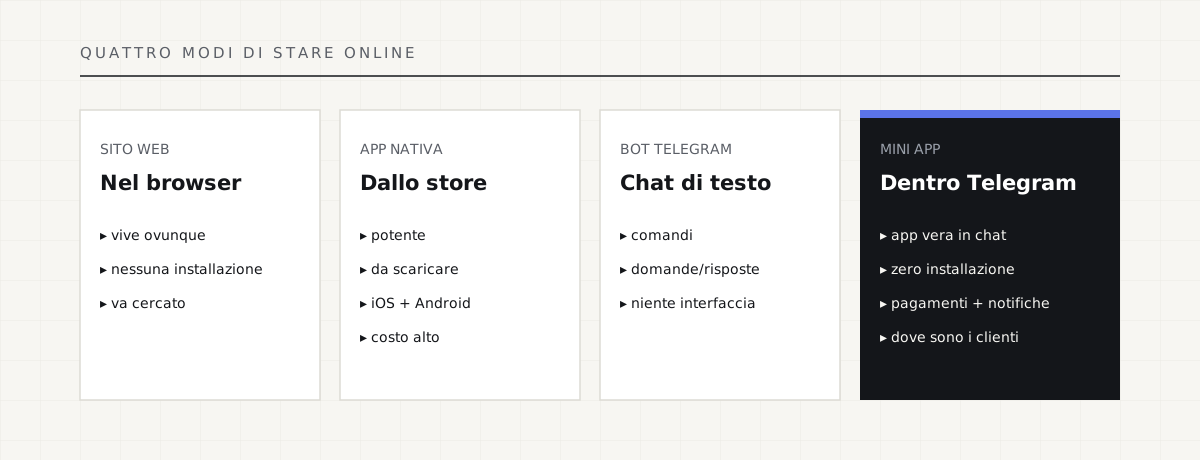
Why inside Telegram, of all places.
A Mini App’s strength isn’t technical, it’s about position: it sits where people already are. Telegram passed one billion monthly active users in 2025, and for many businesses — especially those that talk to regular customers — the chat is already the channel where requests and bookings come in. Bringing a real interface in there removes the worst friction of all: pushing the customer out of the conversation to open a website, find the page, log in.
There’s more than convenience. Telegram’s platform gives Mini Apps real-product tools: built-in payments, targeted notifications, user authentication with no forms to fill in. These are the bricks for a channel that doesn’t just inform, but sells and keeps people. And this is where the space the title calls “the channel Italy is ignoring” opens up: among Italian SMBs Mini Apps are still extremely rare — not for a technical limit, but because almost nobody offers them. Whoever gets there first finds an almost empty field.
A real case: our management system, inside Telegram.
We don’t say it in theory: we built a Mini App for ourselves. The Remarka group runs its translations on an internal system (a TMS), and translators and project managers live in chats more than at desks. Opening the management system in a browser just to check an order’s status was too much, every time. So we brought the system’s key functions into a Telegram Mini App: orders, statuses and notifications right in the chat, with the same logic as the web dashboard.
The numbers are small and real, and we give them as they are: the Mini App was built in two weeks and today handles over ten users and orders a day. The management system fits in your pocket — no app to install, no browser login — and lives where the team already works. It’s exactly the kind of product we know how to build when the interface has to be where people already are, and the same engineering we put into a custom web app for you.
The full case, with a link to the live project →
A custom web app or Mini App for your company →
When it pays off for your business (and when it doesn’t).
Honesty before enthusiasm: a Mini App isn’t for everyone. It pays off when certain conditions recur, and in those cases it’s often the smartest choice — cheaper and faster than a native app.
Where to start.
And when doesn’t it pay off? If your audience doesn’t use Telegram, the door opens onto an empty room: the right channel is another one. If the product needs deep phone functions — advanced camera, sensors, heavy offline processing — or if the store presence is itself part of the brand, then the native app makes a sense a Mini App doesn’t cover. Outside these cases, though, you often end up paying for an app worth thousands of euros to do what a Mini App would do for a fraction of the cost.
The first step isn’t technical, it’s a question: where are your customers already, and what would they like to do without switching apps? From there you design the essential interaction — a few screens, one clear action — and connect it to the systems you already use. A Mini App is still web, and on the web speed matters: it’s worth measuring its performance from the start, as with any site. And if you first want to understand whether your audience is ready for an installable app without a store too, we’ve covered the PWA versus native app comparison separately.
We design your custom web app or Mini App →
Measure your site’s speed for free →
Read also: PWAs for SMBs, when the app isn’t needed →
Sources.
The figures and claims in this article come from here. These are primary sources, not summaries: open them and check for yourself.
- Telegram — Mini Apps for developersThe official documentation: what a Mini App is and how to build one inside Telegram.
- Telegram — the Mini Apps platformHow Mini Apps integrate into Telegram: launch, authorisation, notifications and payments.
- Telegram — the bot platformThe foundations bots and Mini Apps rest on: what a business can automate in chat.
- TechCrunch — Telegram passes one billion users (2025)The figure on the channel’s scale: over one billion monthly active users.
Let’s talk about your website.
Free analysis of your current website; a fixed quote within 24 hours of the call.