
16 JUL 2026
Accessibility statement: a practical 2026 guide
There’s a document few talk about and that, since 2025, many sites must have: the accessibility statement. It’s the least conspicuous part of European Accessibility Act compliance, and for that very reason the most forgotten — with a twist inside: a technically accessible site, but without a published statement, is still not compliant. In this practical guide we look at what the accessibility statement is, what it must contain to be serious and not a copy-paste, the most common mistakes, and how you get to publishing it without relying on an automated score.
What the accessibility statement is (and why it’s mandatory).
The accessibility statement is a public document in which the site states, plainly, how accessible it is: which standard it applies, what works, what isn’t right yet, and who to write to in order to report a problem. It isn’t a certificate you award yourself for show: it’s the way the law asks you to take a verifiable stance before those who use the site, including people with disabilities.
The obligation comes from the European Accessibility Act — EU Directive 2019/882 — applied in Italy since 28 June 2025 for many sites that sell goods or services to consumers. The technical reference standard is WCAG 2.1 level AA. And here’s the point that surprises most: compliance doesn’t end with making the site accessible, it also asks you to declare it. Without the document, the technical work isn’t enough.
The European Accessibility Act, the official text (EUR-Lex) →
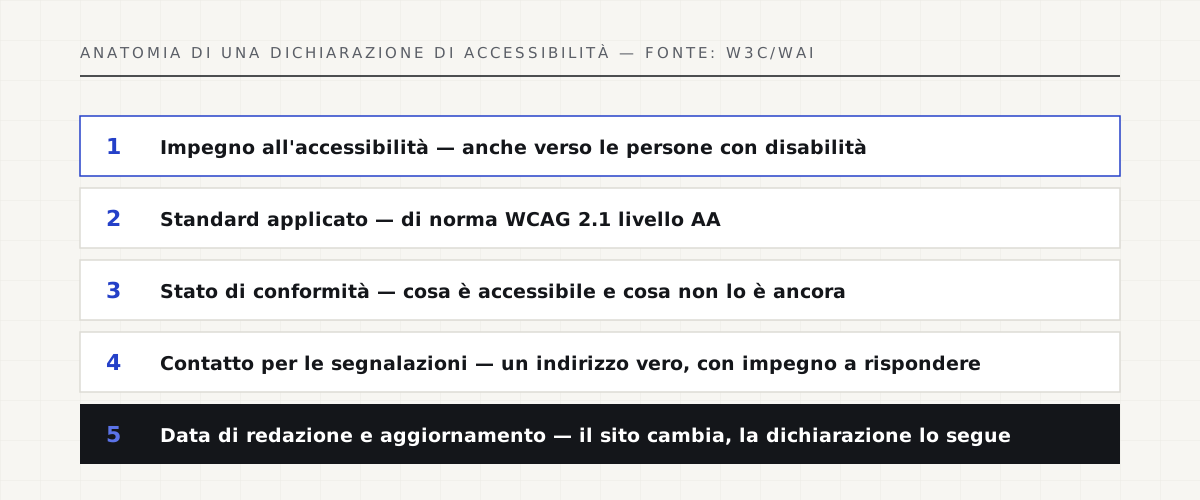
What it must contain: the anatomy of a serious statement.
The World Wide Web Consortium, the body that writes the web’s standards, sets out what a statement should always have — and even provides a free generator. Put into practice, the elements that can’t be missing are few and clear.
The W3C/WAI guide and free generator →
The most common mistakes.
The statements we see go wrong almost always in the same ways. The first: the copy-paste downloaded from another site, with data that has nothing to do with it — worth less than nothing, and in an inspection it shows at once. The second: the “perfect” statement that swears total conformance while the site is full of barriers, that is, a promise that contradicts itself at the first test. The third: lawyer-and-technician jargon, unreadable for the person it should serve — “does not meet Success Criterion 1.2.2” instead of “the videos have no captions.” The fourth: hiding it, buried so deep in the footer that no one finds it. An honest, imperfect statement is worth more than a perfect, false one.
A score isn’t enough: the statement comes after the audit.
There’s a misconception to dismantle: “I passed the automated test, I’m fine.” No. A free automated check is an excellent first step — in a minute it flags contrast, labels and structure — but it catches about a third of the WCAG criteria: what a machine can measure. The rest — keyboard navigation, screen-reader experience, content clarity — can only be checked by hand. A serious statement is written after a real audit, not by pasting a tool’s number.
That’s why the right order is precise: first the audit, automated and manual; then the fixes; then the statement that honestly reports the result; finally a final verification. Whoever sells you the statement without the audit is selling you a frame without the picture.
Check your site’s barriers for free →
EAA guide for online retail (Bird & Bird) →
How we prepare it, in three weeks.
In our service the statement isn’t a separate sheet, it’s the last step of a path. Week 1: automated and manual audit, with the exact scope of the barriers. Week 2: fixes — contrast, form labels, heading hierarchy, keyboard navigation. Week 3: drafting and publishing the accessibility statement, and a verification audit confirming the WCAG 2.1 AA standard once fixes are done. Fixed price after the audit, date in the contract with a penalty, as with all our work.
If you run an e-commerce and want to understand first what you really risk — who’s covered, who’s left out, what fines — we told it separately, without scaremongering. The statement is the finish line; but the journey starts from knowing whether, and how much, the obligation concerns you.
Want us to fix it? The EAA compliance service, at a fixed price →
Read also: EAA 2026, what your e-commerce site really risks →
Sources.
The figures and claims in this article come from here. These are primary sources, not summaries: open them and check for yourself.
- W3C/WAI — Developing an Accessibility StatementThe official W3C guide, with a free generator: what a statement must contain.
- Directive (EU) 2019/882 (EUR-Lex)The text of the European Accessibility Act: the source of the obligation, the statement included.
- WCAG 2.1 — W3CThe technical reference standard (level AA) the statement must cite.
- AccessibleEU — European CommissionThe EU accessibility competence center: it confirms the entry into force on 28 June 2025.
- EAA guide for online commerce — Bird & BirdAn international law firm explains scope, exemptions and obligations for those who sell online.
Let’s talk about your website.
Free analysis of your current website; a fixed quote within 24 hours of the call.