
15 JUL 2026
llms.txt: what it is, and does your site actually need it?
Within a year a new file everyone talks about and almost nobody has appeared: llms.txt. The promise is simple — a little instruction sheet that explains your site to AI models, the way robots.txt has done for search engines for twenty years. But does it actually help, or is it just one more acronym someone will sell you at a premium? Let’s look at what llms.txt is, how to write it in half an hour, and how much it matters today — without inflating it and without waving it off.
llms.txt, in one sentence.
llms.txt is a Markdown text file you place in your site root (yoursite.com/llms.txt) that summarizes, in a machine-readable way, who you are, what you do, and where to find the important pages. It emerged as a proposed standard in 2024 with a clear goal: to give language models — the ones behind ChatGPT, Claude, Perplexity — a clean map of the site, without forcing them to guess among menus, banners and code.
The robots.txt analogy helps, but it isn’t perfect. robots.txt tells crawlers where they may go; llms.txt tells them what your pages are about and how to describe you. It’s the difference between a “no entry” sign and a guide that explains the museum.
The llms.txt specification on llmstxt.org →
What an llms.txt file looks like.
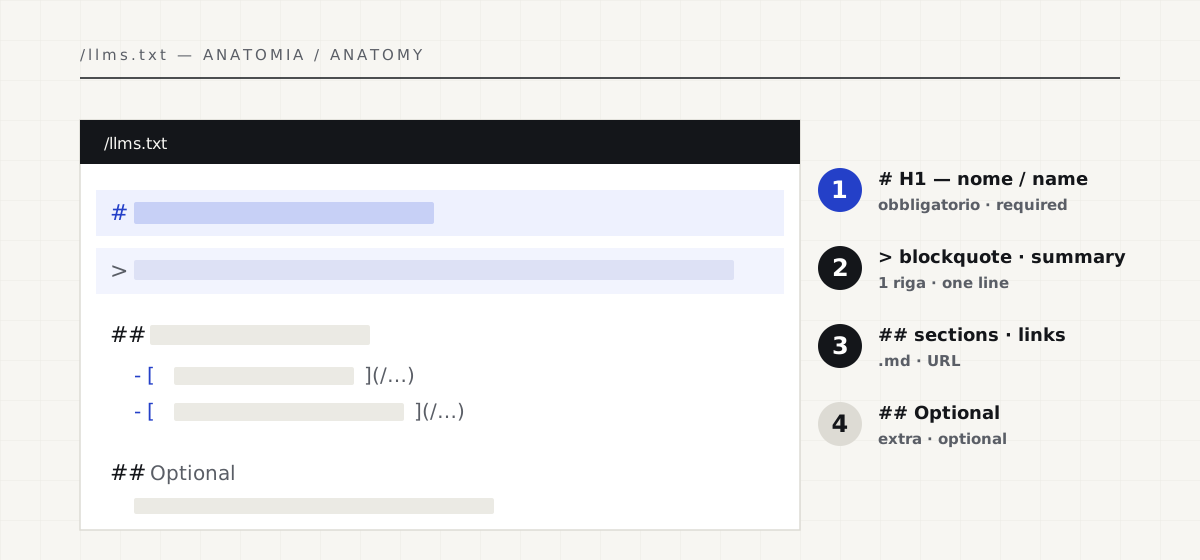
The nice part is that you can read and write it without being a programmer. The structure is that of a tidy Markdown document: a title with the company name, a one-line summary, then sections with links to the pages you want read first — services, about, contacts, documentation.
Does it actually help? The honest answer.
Here we steer clear of two mirror-image lies. The first: “llms.txt is essential, without it you’re invisible.” False. It’s a young standard, not every model reads it yet, and its absence today isn’t a serious error. The second: “it’s a pointless fad.” Also false. It costs half an hour, does no harm, and puts you on the right side of a change that’s speeding up.
Here’s the right way to read it: llms.txt won’t bring you customers on its own, but it removes ambiguity. If a model tries to describe what you do, would you rather it read a map you wrote or piece everything together from a menu and three cookie banners? The answer is obvious, and the cost of the insurance is trivial next to the risk of being described badly.
llms.txt is one piece, not the whole of technical SEO.
A common mistake is treating llms.txt as a magic wand. In reality it’s the newest arrival in a family of signals that have been around for a while: JSON-LD structured data, an up-to-date sitemap, content in readable text rather than only in images, and a robots.txt that doesn’t shut the door on the right crawlers. llms.txt is the cherry; the cake is technical SEO done well.
If you don’t know where to begin, begin by measuring. In a minute you can check whether your site already exposes the four signals models look for — an llms.txt file, AI-crawler access, structured data and a sitemap — and see what’s missing before you write a single line.
It’s part of the technical SEO we deliver →
Create your llms.txt in a minute: free generator →
Read also: how to get found and cited by ChatGPT →
Sources.
The figures and claims in this article come from here. These are primary sources, not summaries: open them and check for yourself.
- The llms.txt proposal (llmstxt.org)The original specification of the format: what an llms.txt file contains and what it’s for.
- OpenAI — crawler overviewThe official documentation on GPTBot and the other OpenAI bots, with the robots.txt rules.
- Anthropic — ClaudeBot and how to block itHow Anthropic declares its crawler and how sites can allow or exclude it.
- Google — crawler overview (Google-Extended)The official list of Google user-agents, including Google-Extended for AI uses.
Let’s talk about your website.
Free analysis of your current website; a fixed quote within 24 hours of the call.