
22 JUL 2026
Privacy-first alternatives to Google Analytics: Matomo and Plausible

Every time a visitor refuses cookies, a slice of your Google Analytics data vanishes — and with a well-built banner that slice is large. At some point it’s fair to ask whether the problem isn’t the tool. Privacy-first alternatives to Google Analytics exist, they’re mature, and for many SMEs they tell you what you actually need with far less regulatory and technical weight. The two best known are Matomo and Plausible. Let’s look at what they offer, how they differ, and — honestly — when it’s worth switching and when it isn’t.
Why look for an alternative.
Google Analytics has two costs that don’t show up on an invoice. The first is regulatory: it’s an American tool that collects personal data, so it requires explicit consent, careful configuration and an ever-evolving handling of transfers. The second is weight: its code is heavy and, together with the banner needed to activate it, it weighs down every page. For a site aiming to be fast, that isn’t neutral.
Privacy-first tools are born to remove both costs. Many use no identifying cookies and collect no personal data, which — depending on the configuration and given the Garante’s framework — can reduce or eliminate the need for a banner for analytics alone. And they have lightweight code that doesn’t slow the site down. Less consent to manage, less weight to load: for an SME that’s often exactly what’s needed.
Matomo: full control of your data.
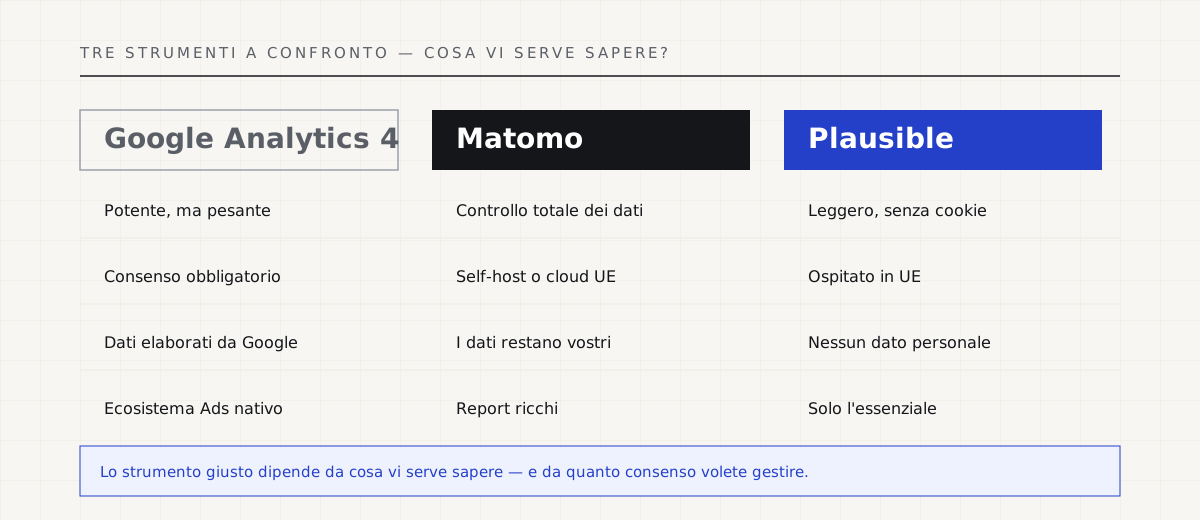
Matomo is the more powerful of the two and is built for those who want to own their data. It’s open source and you can install it on your own server, or use its cloud version hosted in Europe: in both cases the data stays under your control, without going to a third party for advertising purposes. It offers rich reports, close to the ones GA got you used to, and it can run in anonymised, cookieless mode.
It’s the right choice when you need serious analysis and want to keep the helm: sites with significant volumes, strict compliance needs, or simply the wish not to entrust your visitors’ behaviour to Google. In return it asks for a bit more care in setup and maintenance — it’s more a professional tool than a switch.
Plausible: lightweight and cookieless.
Plausible sits at the opposite end of simplicity. It’s a service hosted in Europe, uses no cookies and collects no personal data, and its script weighs a fraction of Google’s. The dashboard is minimal by design: where visitors come from, which pages work, which campaigns bring traffic. No maze of menus — the questions an SME actually asks, with the answer at a glance.
Its hidden advantage is speed: a tiny script and no banner for analytics mean lighter pages, therefore faster and with a smaller environmental impact. It’s the same logic we measure with the tool on a site’s CO₂ footprint: every kilobyte less is a gain for everyone. For a showcase site or a blog that want to understand what works without complications, Plausible is often more than enough.
Privacy-first alternatives to Google Analytics: when it’s worth switching.
In all honesty: it isn’t always worth switching. If your marketing lives inside the Google Ads ecosystem, with remarketing and conversions stitched onto GA4, the native integration is an advantage the alternatives don’t match. In that case it makes more sense to configure GA4 compliantly than to abandon it. Sellers say different things; we say ours: it depends on what you need.
If instead the fundamental questions are enough — how many visitors, from where, which pages, which campaigns — and you want fewer banners to manage, less consent to chase and a lighter site, then Matomo or Plausible are often the better choice. The criterion isn’t “which is the most powerful,” but “which one you’ll actually use and can keep compliant without effort.”
Check your site’s cookies and consent for free →
Measure your site’s weight and CO₂ footprint →
The right tool is the one you can keep compliant.
The moral is the same we hold for every technical choice: the best tool isn’t the one richest in features, it’s the one that suits you and is sustainable over time. A badly configured GA4 is worth less than a Plausible nobody needs to touch. And a well-kept Matomo is worth more than ten dashboards nobody looks at. The right question starts from your needs, not from the most famous name.
When we build or rebuild a site, we set up the analytics together with you: GA4 kept compliant if you need the Google ecosystem, a privacy-first alternative if lightness and simplicity matter. In both cases the rule doesn’t change — measure while respecting your visitors, without collecting data you then won’t know how to defend.
Read also: Google Analytics 4 and privacy in the EU, are you compliant? →
Sources.
The figures and claims in this article come from here. These are primary sources, not summaries: open them and check for yourself.
- Matomo — official websiteThe open-source analytics you can self-host or run in the EU cloud: the data stays yours, with cookieless options.
- Plausible — official websiteLightweight analytics, hosted in Europe, with no cookies or personal data: the fundamental questions with a tiny script.
- Garante Privacy — cookie guidelinesWhy analytics without identifying cookies can lighten consent obligations: the rules the assessment starts from.
- GDPR Regulation 2016/679 — EUR-LexThe legal framework that makes “privacy-first” processing a concrete advantage, not just a marketing label.
Let’s talk about your website.
Free analysis of your current website; a fixed quote within 24 hours of the call.