
18 JUL 2026
Selling abroad online: where to start
A manufacturing company near Brescia makes 40% of its revenue in Germany, but its site is only in Italian — and German customers order by phone, when things go well. A guest house on Lake Como fills its rooms with foreign guests, but presents itself online in a single language. It’s the silent waste of so many Italian SMEs: the product is ready for export, the site isn’t. Selling abroad online isn’t translating the homepage with a plugin: it takes a tool built to be found, understood and chosen by someone living in another market. Let’s look at what it really takes, and the real cases from the Remarka group that have done it — with numbers, not promises.
Why “translating the home page” isn’t export.
The starting mistake is to think of export as a translation problem. Translation is the last layer, not the first. A website for export has to answer questions the Italian version never asks: does the person in Germany find the site when they search in their own language? Do they understand how to buy, with which payments, in which currency? Do they trust a foreign company they don’t know? If even one of these answers is “no,” the finest translation in the world won’t bring an order.
The underlying statistic is unforgiving. CSA Research’s study (“Can’t Read, Won’t Buy”) shows that the vast majority of consumers buy far more willingly in their own language, and many avoid altogether the sites that don’t speak it. And cross-border e-commerce, Eurostat data says, is a growing slice still held back by exactly this: language, trust and logistics. Digital export is about closing that gap, not just firing up the machine translator.
What a website for export really needs.
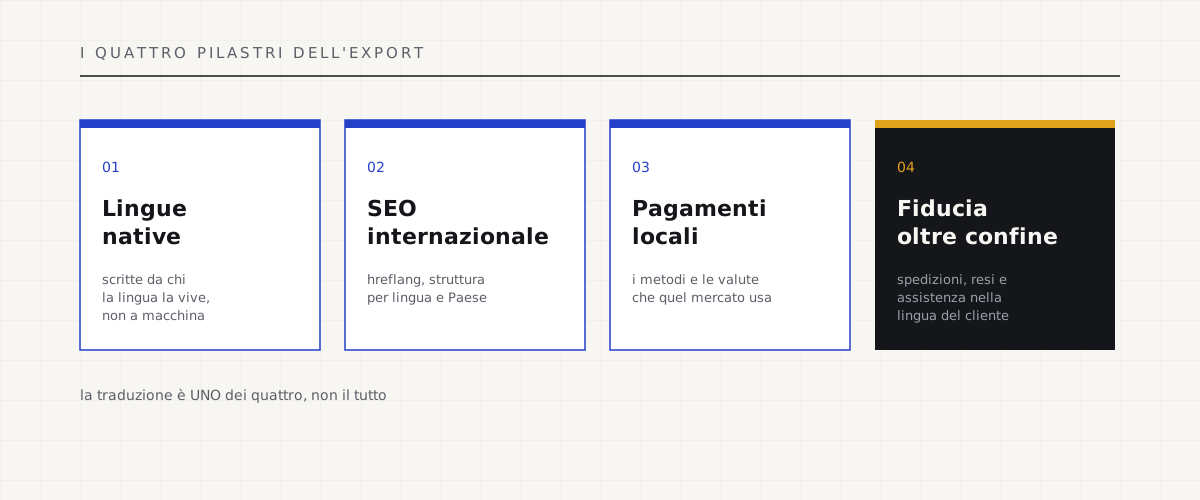
A site that sells abroad rests on four pillars, and translation is only one of the four. Remove one and the market stays shut.
The real cases: who opened a market for real.
We’re not talking in theory. A guest house on Lake Como, ukrinitsy.ru, after a fast, multilingual brochure site saw direct bookings grow by over 450% in a season: foreign guests book from the site, without going through portals. A group agency, with пере.рф, reached the top spot on Yandex for its industry queries with technical SEO alone on an edge-case domain — proof that ranking in a foreign market is made by engineering, not by a lucky name.
And there’s the case we know best, because it’s our calling card: ATT (traduzione.tech) works across more than 40 language pairs and directions, with a site built to speak the B2B customer’s language in every market. The same engineering — native languages, international SEO, a clean structure — is what we put into an export-ready site for you. The cases, each with a link to the live project, are all open and verifiable.
Export-ready website: what it includes and for which markets →
The group’s real cases, with a link to the live project →
How much it returns: measuring before you start.
Opening a market costs money, and it’s right to ask whether it pays before you start. The question isn’t “how much does translation cost,” but “how much is one more customer worth in that market, and how many do we need to pay back the work.” A catalogue translated by native speakers and a checkout stripped to the bone are the two levers that shift the most direct sales abroad — but they must be sized against the expected return, not against enthusiasm. Better to start with one market done well than five done by halves.
There’s a tool to start reasoning with: a localisation-return calculation that lines up the cost of the language work and the potential sales to work out which language to start from. And if the first market is right next door — Germany, Austria, Switzerland for those exporting manufacturing — the technical piece not to get wrong is still hreflang, which we’ve covered separately.
Calculate your localization ROI →
Multilingual websites with native-speaking editors →
Read also: multilingual website, hreflang without the headache →
Sources.
The figures and claims in this article come from here. These are primary sources, not summaries: open them and check for yourself.
- CSA Research — “Can’t Read, Won’t Buy”The research on buying behaviour: the majority buy in their own language and avoid sites that don’t speak it.
- Eurostat — e-commerce statisticsThe European data: how much cross-border e-commerce weighs and what still holds it back.
- Google Search Central — multi-regional and multilingual sitesHow to set up language and country to get found correctly in foreign markets.
An export-ready site for your foreign markets, at a fixed price →
Let’s talk about your website.
Free analysis of your current website; a fixed quote within 24 hours of the call.