
05 MAY 2026
A website in four languages: costs, timelines, and the mistakes to avoid
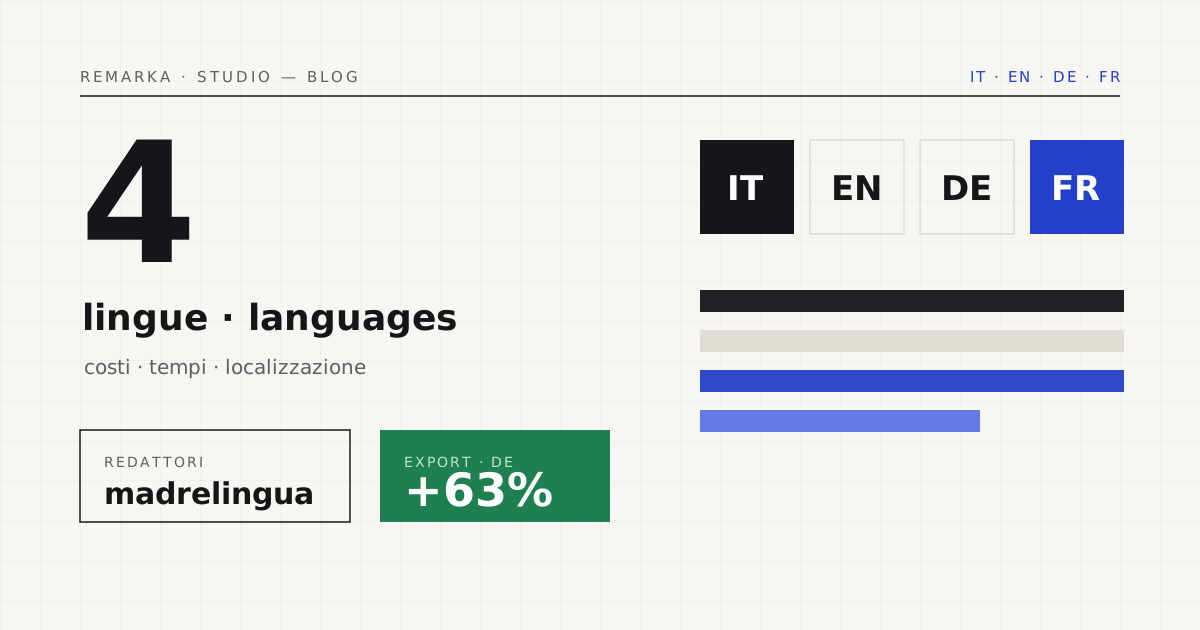
A German customer opens your machine-translated product page, reads a sentence that in their language sounds clumsy, and closes it: they didn’t think “bad translation”, they thought “unprofessional company”. That’s how a register error costs an order before even an email. Machine translation is enough for a menu or opening hours; it’s not enough where you sell. In this article: when machine translation is worth it, when you need a native speaker, and what really changes in costs and timelines per language, with a real case from the Remarka group.
When machine translation is enough (and when it isn’t).
Today’s machine translation is excellent for understanding and being understood on simple things: opening hours, an address, the neutral description of a service. If your goal is for a tourist to find the phone number, it works fine. The problem arises where words sell: a technical product page, a page that has to persuade, a text where tone counts as much as content. There, machine translation produces sentences that are “correct but flat”, and sometimes register errors that, in the customer’s language, sound clumsy or unprofessional.
A simple way to decide: ask yourself whether that page informs or sells. Pages that inform — hours, contacts, neutral descriptions — hold up fine with machine translation, perhaps with a proofread. Pages that sell — product pages, landing pages, texts that have to persuade — should be entrusted to a native speaker, because there a tone error doesn’t raise a smile: it closes the page.
What changes in costs and timelines, per language.
Adding a language isn’t hitting a “translate” button. It’s translating the texts with a native speaker, adapting the sales ones, translating even what you don’t see — titles, descriptions for Google, error messages — and setting up the technical signals (hreflang) that tell the engine which version to show to whom. The cost grows with the real words to work on, not with the number of little flags; the timelines, with the number of pages that really have to persuade, not just inform.
In practice, for an average company website, adding a well-done language means a few days of work for translation and adaptation, plus the technical setup. Much less than feared, if you start from the right texts; much more than “zero”, which is what those selling you a machine-translation plugin as if it were a foreign version of the site promise.
The mistake that costs customers: translating without localizing.
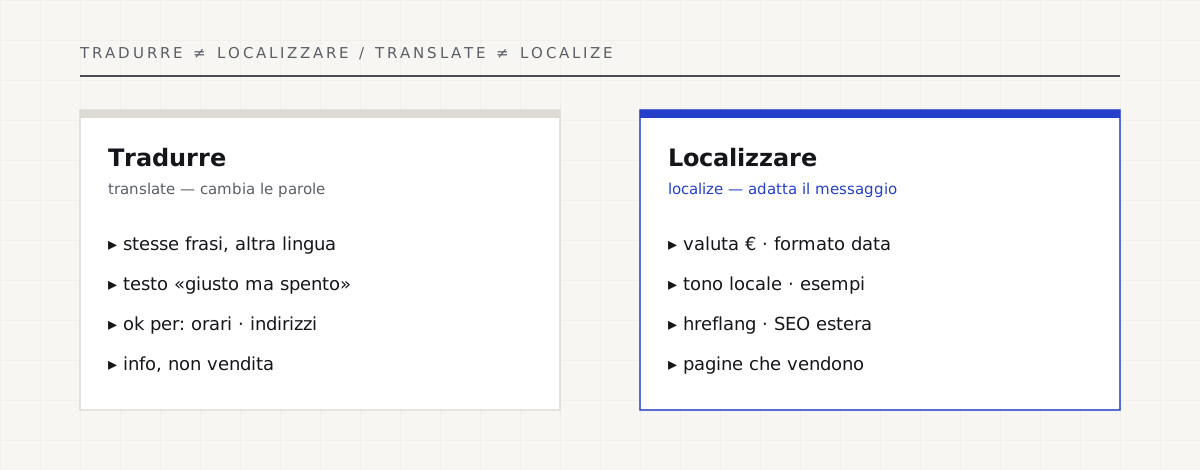
Translating is changing the words; localizing is changing whatever it takes for the message to work in that market. A price in the right currency, a date in the local format, an example that’s understood in Germany but not in Italy, a more direct or more formal tone depending on the country. A classic CSA Research study has said it for years with a title that’s already a thesis: “Can’t Read, Won’t Buy” — if I can’t read it in my language, I won’t buy it. It still holds, and it holds above all where there’s a cart.
A real case: localisation that generates orders.
The site of ATT (traduzione.tech), live since 2022, brings the agency around 20 orders a month across more than 40 language pairs and directions — a real case from the Remarka group, not a third-party client, with a link to the live project at /en/case-studies/. It isn’t the translation alone: it’s the translation done by people who sell, combined with a fast site and a structure built for the B2B client. It’s exactly the model of our Export Ready service — the site and its foreign version under a single contract, with native-speaking editors.
Multilingual websites with native-speaking editors →
Calculate the ROI of a foreign version of the site →
Sources.
The figures and claims in this article come from here. These are primary sources, not summaries: open them and check for yourself.
- CSA Research — “Can’t Read, Won’t Buy”The classic study: the majority of consumers buy only in their own language.
- Google — multi-regional and multilingual sitesThe official guide to how to structure a site for multiple countries and multiple languages.
- Google — localized versions and hreflangHow to tell Google which language version to show to whom: a technical detail that matters.
- Eurostat — e-commerce statisticsThe weight of cross-border e-commerce in Europe, the market a foreign version opens up.
Let’s talk about your website.
Free analysis of your current website; a fixed quote within 24 hours of the call.