
23 JUL 2026
Google’s AI Overviews: how to stay visible when AI answers
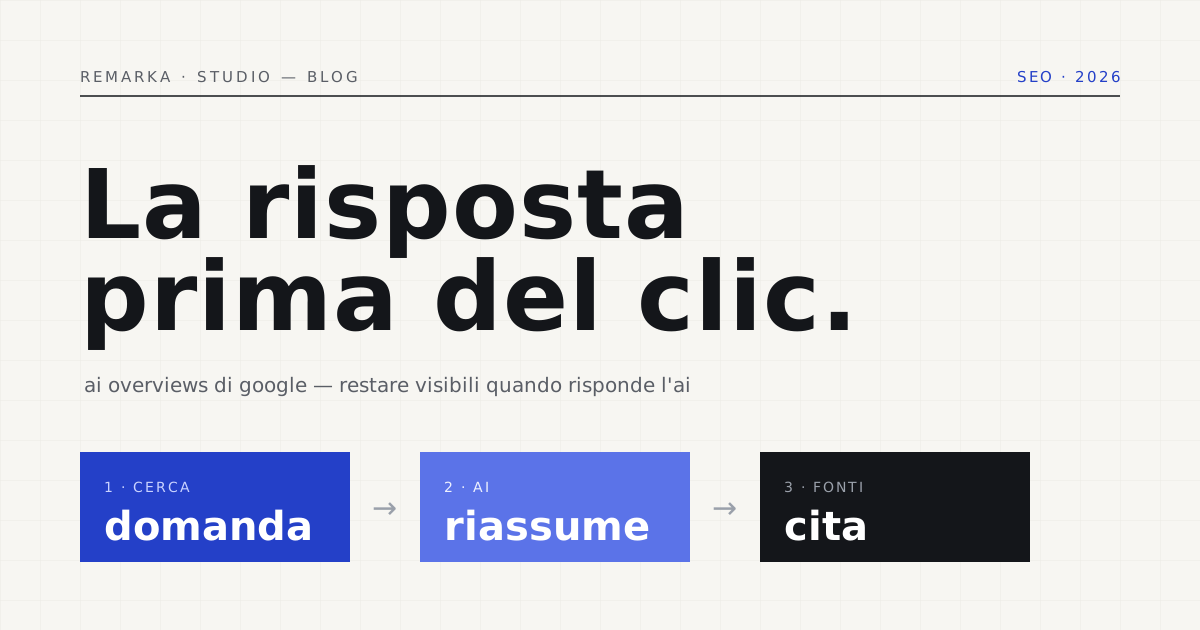
Ask Google a question and, more and more often, the first thing you read isn’t a link: it’s a paragraph written by AI that summarizes the answer. These are called AI Overviews, and they’re changing how people find — or no longer find — websites. If you run a website, the question is concrete and a little unsettling: if Google answers on its own, will anyone still click through to my link? Let’s look at what Google’s AI Overviews really are, what changes for your website’s traffic, and above all what you can do to stay visible when a machine answers at the top of the page.
What Google’s AI Overviews actually are.
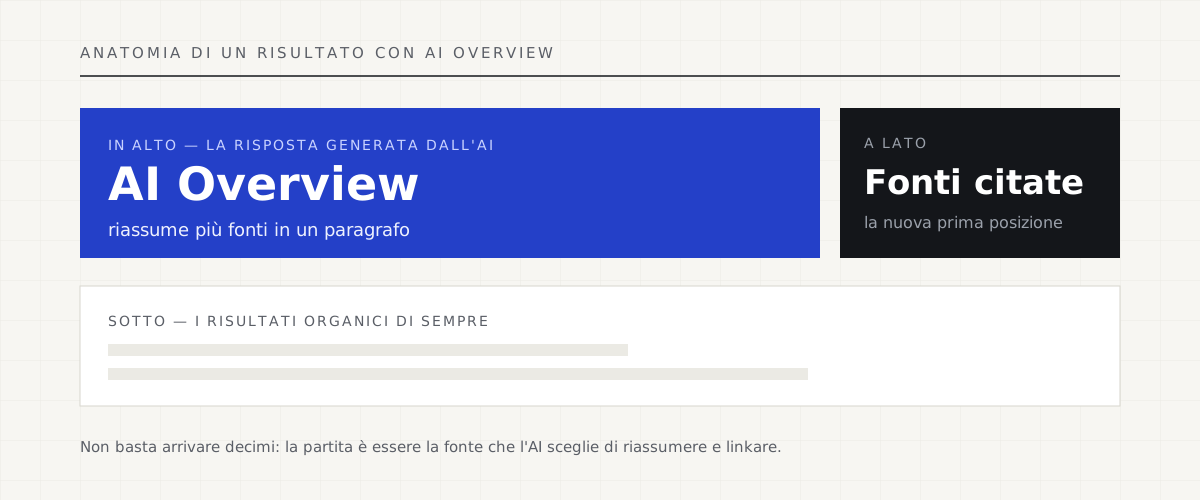
AI Overviews are the answer boxes Google automatically generates at the top of results for many questions. Instead of just a list of blue links, an AI-written summary appears that pulls together information from multiple sources, with a few links to dig deeper alongside it. Google introduced them after a long testing phase — they used to be called Search Generative Experience — and is rolling them out to a growing number of languages and countries.
They don’t show up for every search. Google tends to display them mainly for explanatory questions — “how does it work”, “what’s the difference between”, “why” — where a summary genuinely helps, and much less for navigational or clearly commercial searches. Understanding when they appear is the first step: AI Overviews don’t replace Search, they change the top of the page for a certain kind of question.
What changes for your website’s traffic.
The legitimate fear is called “zero-click”: if the answer is already there, the user doesn’t click. For certain simple questions that’s true, and some of the more superficial informational traffic will shrink. But that’s half the picture. The other half is that people who want to go deeper click exactly the links cited inside the Overview: being one of the cited sources becomes the new first position. The game is no longer just “arrive first” — it’s “be the source AI chooses to summarize and link”.
The kind of visit changes too. Someone arriving after reading a summary is better informed and closer to a decision: fewer clicks, but often more qualified ones. That’s why it makes little sense to chase the lost volume on trivial questions; it’s worth aiming at the questions where your expertise makes the difference and where an automatic answer alone isn’t enough. An “AI-ready site” test tells you whether your pages are readable and citable by generative systems.
Check for free whether your site is readable and citable by AI →
How to stay visible in AI Overviews.
The good news is that you don’t need secret AI-only SEO: Google itself has repeated that there are no dedicated tricks for AI Overviews, and that the same rules for quality content apply. Content that genuinely answers a real question, written by someone who knows the subject, has the best odds of being picked up. The usual fundamentals — helpful and original content, demonstrated experience, clarity — matter more than ever, because AI summarizes what it finds trustworthy.
In practice: answer the question early and directly (one clear sentence in the opening paragraphs is worth more than a thousand roundabout words), structure the page with headings that mirror real questions, and back up your expertise with data, examples and verifiable sources. This is the E-E-A-T approach: experience, expertise, authoritativeness, trustworthiness. You don’t win AI over by faking it; you win by genuinely being the best source on that question.
Technical SEO that makes a page readable and citable →
Read also: E-E-A-T, how Google judges your credibility →
Structured data and sources: helping AI trust you.
If you want an automated system to understand and correctly cite your page, help it read it. Structured data (Schema.org) explicitly describes what’s on the page — an article, a company, a product, a FAQ — and makes it easier for Google to match your answer to the right question. It’s not a magic shortcut into the Overview, but it removes ambiguity: the machine works better when content is clean and well labeled.
Where what you write comes from matters too. A claim backed by an authoritative source carries more weight than an opinion tossed out there — for a reader and for a system that has to decide whom to trust. Citing primary sources, keeping pages up to date and not padding text with empty words is, at the same time, good writing and good SEO in the age of AI Overviews.
This isn’t the end of SEO — it’s a new chapter of it.
AI Overviews are unsettling because they put an answer between your site and the person searching. But the underlying mechanism hasn’t changed: Google rewards whoever answers a real question best, and now that answer can end up cited at the top. Whoever built honest, competent content starts ahead; whoever lived off thin pages optimized for the engine rather than for people will struggle more. This isn’t the end of SEO: it’s the end of clever SEO.
Our approach hasn’t changed with the arrival of AI: we build fast, readable, honest websites, where every page genuinely answers a question. That’s what readers like, what engines like and — it turns out — what the machines that now summarize the web like too. Everything else is a shortcut that ages badly.
Read also: topical authority, why a blog beats 100 scattered keywords →
Sources.
The figures and claims in this article come from here. These are primary sources, not summaries: open them and check for yourself.
- Google Search Central — AI features in SearchThe official page on generative features: how Google uses AI in results and what matters for appearing in them.
- Google Search Central — creating helpful contentThe same rules as always: helpful, original content made by people who know the subject. Google reiterates there are no tricks for Overviews.
- Google Search EssentialsThe basic rules for being found on Google: technical, quality and spam policies. The starting point for any website.
- Google — How Search WorksThe official explanation of how Google finds, ranks and presents answers: useful for understanding where Overviews come from.
Let’s talk about your website.
Free analysis of your current website; a fixed quote within 24 hours of the call.