
24 JUL 2026
Naples and tourism: a multilingual website that gets bookings
A hotel in the old town that lives on direct bookings, a B&B in the Quartieri Spagnoli, a restaurant the American tourist finds from their phone at noon: in Naples the draw is there and it’s very strong — 14 million overnight stays in 2024, the leading destination of southern Italy. But the tourist looking for you is often foreign, reads reviews in English and books online before even writing to you. A Naples tourism website that opens the rooms in six seconds, or that exists only in Italian, is a booking handed to a portal. Let’s see why a well-built multilingual website gets direct bookings, and how it’s built.
Naples, tourism and an audience arriving from outside.
Tourism in Naples has grown by almost half in three years, driven in part by the port: 1.83 million cruise passengers in 2024, Italy’s second cruise port (Central Tyrrhenian Sea Port Authority). It’s a largely international audience that, before booking, does one thing only: it searches online, reads reviews, compares photos. If your hotel or restaurant doesn’t appear — or appears with a site only in Italian that the tourist from Boston doesn’t understand — the booking goes elsewhere.
Here’s the point: in Naples the tourism site necessarily works in more than one language. It’s not an international affectation, it’s the minimum for intercepting whoever is looking for you in their own language. And it makes a concrete economic difference, because a direct booking — with no portal commission — is worth far more than an intermediated one. A multilingual website that gets direct bookings is, literally, margin that stays with you.
Why the tourist books in their own language.
People buy in the language they understand. It’s by now a classic finding of CSA Research («Can’t Read, Won’t Buy»): the great majority of consumers prefer to buy — and to book — when the information is in their own language, and many avoid altogether sites only in English or only in the local language. For a tourist choosing where to sleep in Naples, a site in their own language isn’t a luxury: it’s the reason they trust it and click «book».
And translating any old way isn’t enough. A slapdash machine translation, with errors and unnatural phrasing, achieves the opposite effect: it signals carelessness to the very person about to entrust you with their holiday. A credible Naples tourism site has versions written by someone who really speaks the language — English first of all, then the languages of the markets that bring you the most guests — with text that sounds native, not machine-translated.
Native translation or AI: the difference the customer feels →
CSA Research — Can’t Read, Won’t Buy →
Multilingual done right: hreflang and international SEO.
A site in several languages isn’t an Italian site with a little flag. For it to really work on Google you need the right technical part: the hreflang attribute, which tells the engine which version to show whoever searches in English, German or French, so the American tourist gets the page in English and not the one in Italian. Done badly, hreflang creates duplicates and confusion; done well, it puts the right version in front of the right person.
To this are added the rules for international sites that Google itself documents: clear URLs for each language, genuinely translated content (not just the menu), consistency between versions. It’s work invisible to the visitor but decisive for ranking: a well-structured Naples tourism site appears when a Dutch person searches «hotel Naples old town», not only when an Italian searches «hotel Napoli centro».
Reviews: social proof in every language.
In tourism the decision almost always goes through reviews. Nearly all travellers read them before booking, and in Naples many are in English or other languages: your site and your Google profile must collect and show them, not hide them. A well-kept Google Business Profile, with real photos and recent reviews, often convinces before the tourist even opens the site.
Social proof, though, must be handled honestly: genuine reviews, requested methodically from those who had a good experience, never invented. In tourism a fake review that gets exposed is permanent damage, because it circulates on international platforms that don’t forget. Trust is built by showing what guests really say, in the language they say it.
Read also: reviews and social proof, without inventing anything →
Websites in Naples: tourism, port and aerospace →
Where to start, to get direct bookings.
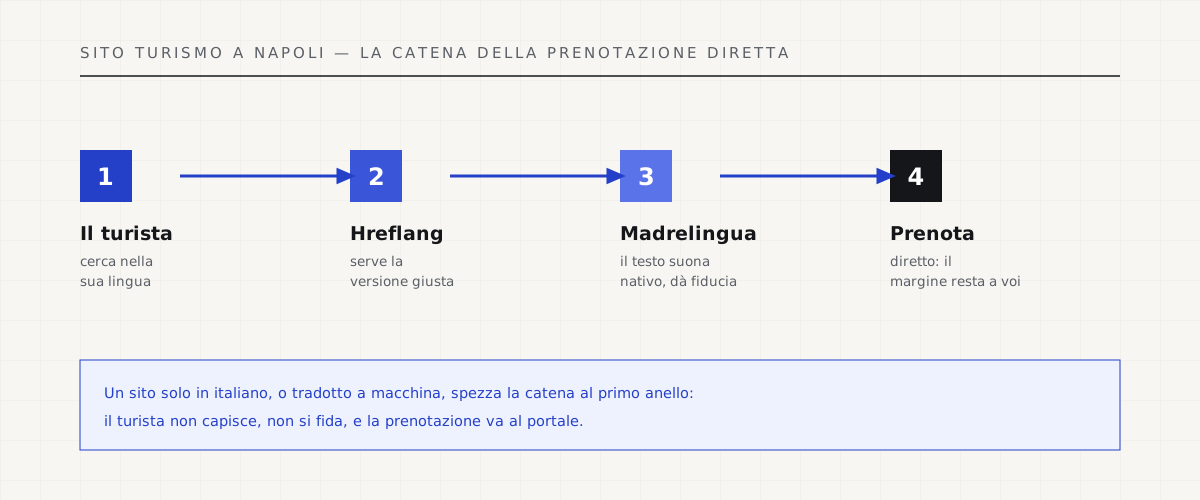
The order makes sense: first a fast, mobile-readable site (that’s where the tourist chooses), then the languages that really matter for your audience — English always, the others depending on who brings you the most guests —, translated by native speakers and with correct hreflang. Finally the well-kept Google profile and the reviews. Each link adds direct bookings; skipping one hands them to the portals.
We start from the numbers: how fast your site loads today, how the English version behaves, what Google sees when a tourist searches from abroad. We work across the whole of Italy and in Naples we meet by video call or, by appointment, we come to you. A well-built Naples tourism site isn’t an expense: it’s the reception desk that works at night too, in all the languages of your guests.
Multilingual websites: how we build them, language by language →
Read also: hreflang for a multilingual website, without the headache →
Sources.
The figures and claims in this article come from here. These are primary sources, not summaries: open them and check for yourself.
- CSA Research — Can’t Read, Won’t BuyThe reference research: the majority of consumers prefer to buy and book in their own language.
- Google — managing multi-regional and multilingual sitesThe official rules for an international site: URLs, translated content and consistency between versions.
- Google — localized versions and hreflangHow to tell Google which language version to show each user, without creating duplicates.
- BrightLocal — Local Consumer Review SurveyThe consumer survey: almost everyone reads reviews before choosing, in tourism more than ever.
Multilingual websites translated by native speakers, with correct international SEO →
Let’s talk about your website.
Free analysis of your current website; a fixed quote within 24 hours of the call.