
22 JUL 2026
What a well-built business website includes: the checklist

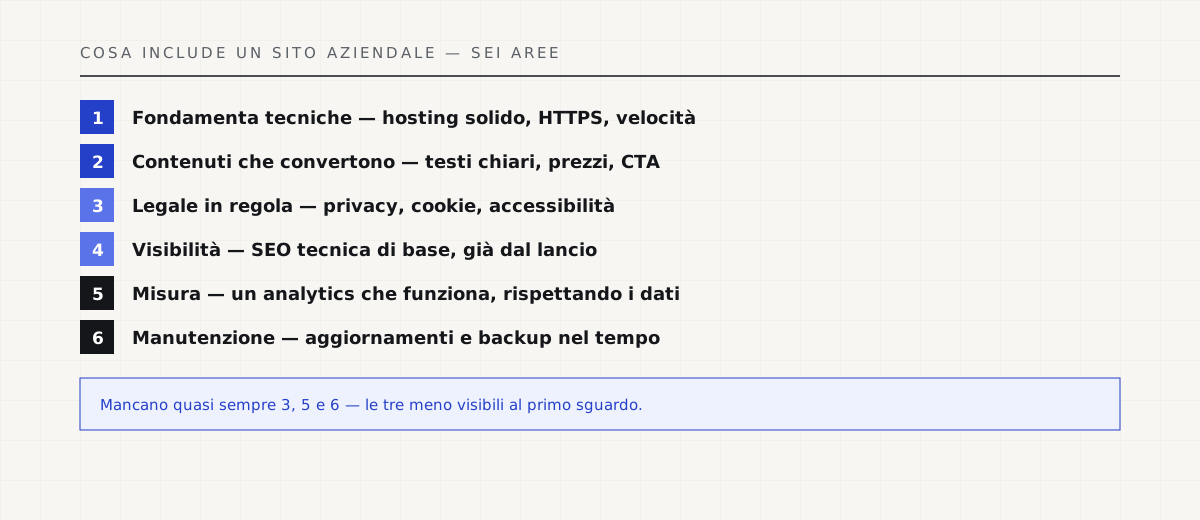
When people talk about what a well-built business website includes, the mind almost always jumps to design: the logo, the colours, the professional photos. Yet it’s common to find — behind very polished graphics — a site with no reliable hosting, no cookie policy, no way of knowing whether it’s actually bringing in customers. A site like that is an empty shell: nice to look at, fragile to use, and over time a hassle to keep running. In this article we look at what a business website really needs to contain to be an investment rather than a gamble: six areas, from the technical side no one sees to the one that’s noticed at first glance, with what’s most often found missing in practice.
The technical foundations: solid hosting, HTTPS, performance.
The part you don’t see is the one holding up everything else. Solid hosting means a site that stays online when it gets more visits than usual — a campaign that works, a mention in a local paper — and that recovers quickly if something goes wrong. Then you need HTTPS on every page, not just the contact form: without it, modern browsers flag the site as “not secure,” and that’s the first detail that pushes away a wary visitor.
Then there’s performance, which can be measured, not just guessed at. web.dev, the reference site on these topics, defines the Core Web Vitals thresholds: how long it takes for a page’s main content to load, how quickly it responds to the first click, whether it “jumps around” while loading or stays stable. These aren’t details for techies: they’re the difference between a visitor who waits and one who closes the tab before even reading a line.
Content that converts, not just fills space.
A site full of pages isn’t a site with useful content. What’s actually needed is little and targeted: a homepage that says in one line what you do and for whom, service pages with concrete information — what the offer includes, rough timelines, a price range where possible — and a clear call to action on every page, not buried at the bottom after three screens. A generic “about us” page, with no real face or story behind it, tells the visitor there’s no one on the other side to actually talk to.
Photos matter as much as the copy: a few genuine images of your own work beat an anonymous stock gallery downloaded by everyone, identical to ten competitors’. And if you publish testimonials or real case studies, they need to be told honestly — with a name, context, verifiable details — because a customer spots a fake or overly generic review at a glance, and trust lost here is hard to win back on the rest of the site. Two concrete cases, told properly, beat ten anonymous, faceless lines.
The legal side: privacy, cookies, accessibility.
If the site collects even a single piece of data — a contact form, a newsletter — it needs a clear privacy notice explaining how you use it, and a genuine cookie policy, written for your own site rather than copied from someone else’s: Italy’s data protection authority (Garante) publishes precise guidance on how cookie consent must work before any non-essential script runs. A banner that pretends to ask for consent but loads everything in the background anyway isn’t a formality you can skip: it’s a real risk.
Then there’s accessibility: a site readable even by someone using a screen reader or navigating by keyboard only, without a mouse. The W3C, the organisation that writes the web’s technical standards, publishes the WCAG guidelines — the international reference for understanding what makes a site genuinely accessible: sufficient contrast, alt text on images, forms that can be filled in without seeing the screen. It isn’t a niche detail: it’s part of a site’s quality that a real slice of visitors notices, very much so, when it’s missing — and increasingly it’s also a legal requirement, not just common sense.
Measure your site’s privacy and accessibility for free →
Visibility: the technical SEO basics.
A site can have excellent content and still stay invisible on Google if it’s missing the technical basics of SEO: a title and description written for every page, a sitemap that helps search engines find every page, clean and understandable URLs, images with alt text. Google gathers this guidance in its own official documentation for people working on search, and it’s the foundation every ranking starts from, well before writing a single blog post or thinking about a keyword.
There’s no need to chase every technicality: what matters is having these foundations in place from launch, not added months later when lost indexing can’t be recovered with a wave of a wand. A site with no sitemap, no titles written with any care, with automatically generated, unreadable URLs, already starts uphill against a competitor who took care of these details from day one. It’s one of the reasons why, when we design a business website, technical SEO goes into the work from day one, not as an extra item tacked on at the end.
Measurement and maintenance, over time.
A site that measures nothing doesn’t let you understand what’s working: a properly configured analytics setup — respectful of privacy, not a tool left on default — tells you where enquiries come from and which pages lose them along the way. We’ve covered this in more detail when talking about the alternatives to Analytics that respect data from the start.
And a launched site isn’t a finished site: it needs maintenance — regular updates, genuinely tested backups, a periodic check that everything still works like day one. We go into the detail when we talk about what’s needed after launch, and what you lose if one day the site simply disappears.
What a well-built business website includes, then, isn’t a list of aesthetic preferences: it’s this combination — technical foundations, content, the legal side, visibility, measurement and maintenance — that has to hold up together and over time. Miss even one of these areas and the site stays a nicely painted shell: good to look at, fragile to use.
What a business website includes, our approach →
Measure your site for free: full check-up →
Read also: how to read a website quote →
Sources.
The figures and claims in this article come from here. These are primary sources, not summaries: open them and check for yourself.
- web.dev — performance and Core Web VitalsGoogle’s reference on a page’s speed and stability: the thresholds that make a site genuinely fast.
- Garante Privacy — official websiteItaly’s data protection authority, with guidance on notices, cookies and data subjects’ rights.
- W3C WAI — web accessibility (WCAG)The international accessibility guidelines: the reference for understanding what makes a site usable by everyone.
- Google — Search documentationGoogle’s technical SEO basics: titles, sitemaps, indexing, before any content at all.
Measure how many of these six areas your site covers, for free →
Let’s talk about your website.
Free analysis of your current website; a fixed quote within 24 hours of the call.