
22 JUL 2026
E-commerce platform: how to choose between Shopify, WooCommerce and custom-built
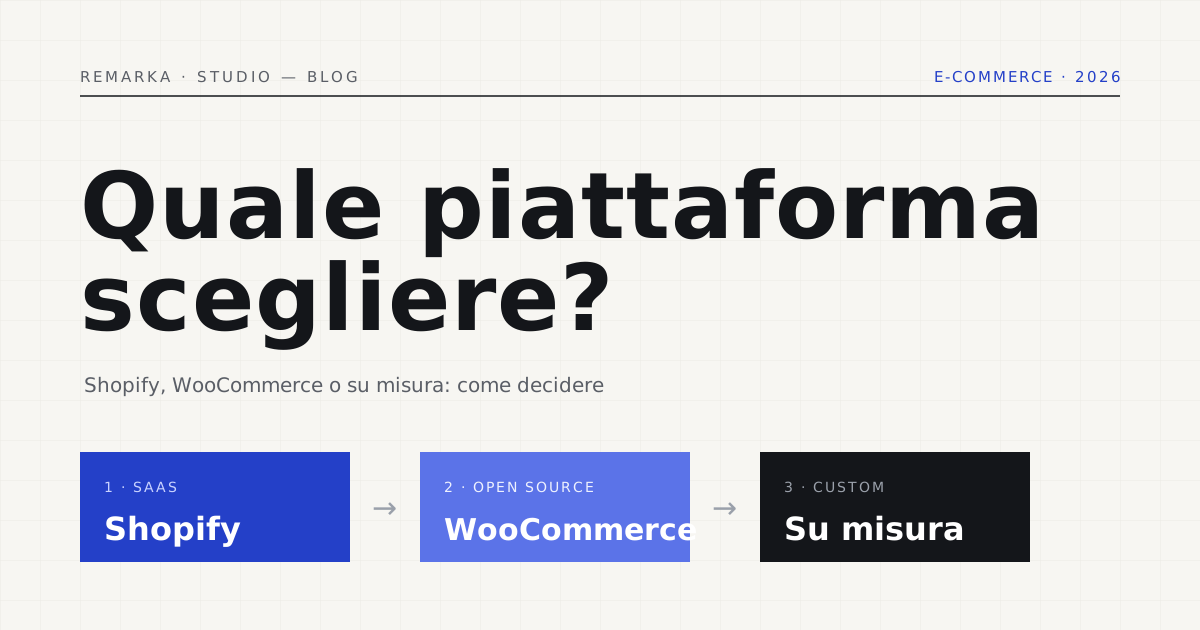
You’ve decided to open an online shop, and the first question stops everything: which e-commerce platform should you choose? Two minutes of searching is enough to find opposite opinions — some swear by Shopify alone, some won’t budge from WordPress, some tell you custom-built is the only serious choice. The truth is less tidy than a ranking: there’s no single best platform, only the right one for your catalogue, your monthly budget and how much time you want to spend on maintenance. In this article we compare Shopify, WooCommerce and custom development honestly, without going easy on any of the three.
Which e-commerce platform to choose: the question that actually matters.
The question “which e-commerce platform should I choose” actually hides three smaller questions: how many products you have and how much they change over time, how much budget you can sustain every month beyond the initial build, and who will handle the updates once the shop is online. Answering these three things before you look at a single price saves you months of work redone from scratch.
It’s not a choice to make on a whim, or by copying whatever your biggest competitor uses. A shop with fifteen products managed by hand has opposite needs from one selling thousands of SKUs across several warehouses. That’s why, before comparing features and prices, it’s worth getting an honest assessment of what your project actually needs.
There’s also a question almost no one asks at the start, and it’s the most important one: a year from now, who will update the shop, add products, check that everything still works? If the answer is “no one in particular,” the choice of platform changes considerably compared to a case where you already have someone — in-house or external — looking after it continuously. A platform that’s perfect on paper but left to itself, with no updates or checks, ends up costing more than a simpler one that’s properly looked after.
Our e-commerce service, from choosing the platform to going live →
Shopify: online in an afternoon, a monthly fee forever.
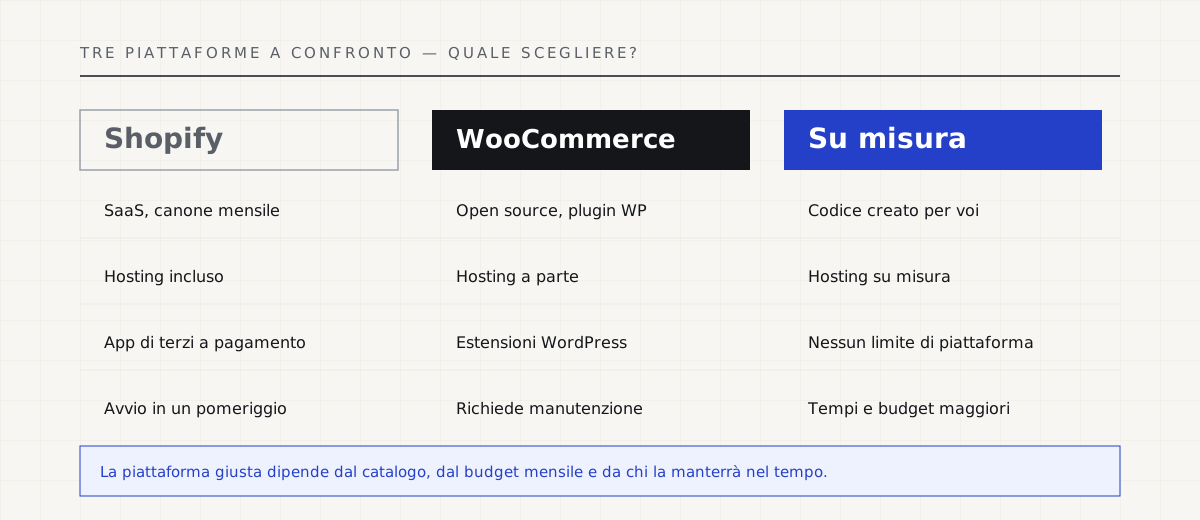
Shopify is a SaaS platform: you pay a monthly fee and in return you get hosting, baseline security and updates managed by the platform, inside a dashboard built for people who don’t want to touch a line of code. You can open a working shop — catalogue, cart, payments, shipping — in an afternoon, picking a theme from those available and connecting the apps you need from their marketplace.
The flip side of that convenience is that you’re inside a closed ecosystem. Any feature outside the standard set often has to come from a paid third-party app, and the fee keeps arriving every month even when the shop is quiet. It’s a great fit for anyone who wants to launch fast and has, or wants, no in-house technical skills; it gets tighter once the shop grows and needs deep customisation the platform doesn’t offer.
It’s also worth it for anyone already selling elsewhere: Shopify integrates well with the most common marketplaces and social channels, which makes it convenient for managing several sales channels from a single dashboard without connecting them by hand one by one. The trade-off stays the same — less technical work, less room to manoeuvre when you need something genuinely different from the standard.
WooCommerce: the shop built inside WordPress.
WooCommerce is an open-source plugin that turns a WordPress site into a fully functioning shop. The software is free, but free doesn’t mean cost-free: you need suitable hosting, a theme, and almost always some paid extensions for payments, shipping or invoicing. In exchange you get near-total freedom over the code, the design, and how content — product pages, a blog, informational pages — lives alongside the shop on the same site.
That freedom has a price that doesn’t show up on the receipt: maintenance is on you. Updating WordPress, the theme and the plugins, keeping an eye on security and backups isn’t optional once the shop is handling payments and customer data — it’s the least visible part of the work, the one that makes the difference between a solid shop and a fragile one. If you already have a WordPress site that works well, WooCommerce is often the most natural path; if you’re starting from zero with no one to look after it, it’s a commitment to factor in from day one.
The advantage that’s less obvious, but matters a lot, is about content: being WordPress through and through, a WooCommerce shop can host a blog, guides and informational pages in the same environment as the catalogue, with the same management system. For anyone aiming to be found through content too — not only through paid campaigns — that’s no small detail.
Custom-built: when it’s worth building from scratch.
Custom development makes sense when the shop has needs no standard platform covers well: complex pricing logic, tight integration with an existing management system or warehouse, a buying experience very different from the usual catalogue-cart-checkout pattern. It’s the path with the most control — and also the one with the highest upfront investment and the longest timeline.
Typical cases where we genuinely see custom-built as necessary: a B2B catalogue with different price lists and discounts for each customer, a shop that has to talk in real time with a warehouse management system already in use, or a sales model — subscriptions, product configurators, multi-vendor marketplaces — that standard platforms can only support through plugin-on-plugin acrobatics. In these cases, dedicated code costs less than the compromises in the long run.
For most Italian small and medium businesses, though, custom-built isn’t the starting point: it’s a later step, once Shopify or WooCommerce genuinely start feeling too tight. Before heading down this road it’s worth having clear numbers — what it realistically costs to open and run an e-commerce business in Italy with each of the three solutions, to compare not just the features but the bill at the end of the year.
How much an e-commerce site costs in Italy: the real spend, not just the quote →
Which e-commerce platform to choose based on your shop.
If we had to boil it down to a compass: Shopify for those who want to launch fast, have a simple catalogue and would rather pay a fee than think about hosting and security. WooCommerce for those who already have, or want to build, a solid WordPress site, perhaps with a blog or editorial content alongside the shop, and are willing to handle — or have someone handle — the maintenance. Custom-built for those with processes neither standard platform can represent without acrobatics.
Whichever platform you choose, loading speed and a well-cared-for buying journey remain decisive: every extra second of waiting is a customer closing the product page, whatever the platform. Don’t let yourself be guided only by the plan’s price or the trend of the moment: let yourself be guided by what the shop will need to do a year from now, not just what it needs tomorrow.
If you still have doubts, the most concrete way to settle them isn’t reading yet another ranking online, but starting from how your site or project stands today: what’s already there, what’s missing, what risks slowing you down as soon as the shop really starts to grow.
Measure your site before choosing a platform — free check-up →
Sources.
The figures and claims in this article come from here. These are primary sources, not summaries: open them and check for yourself.
- Shopify — official platformShopify’s official page: how the subscription-based SaaS model works, what it includes and how apps and themes work.
- WooCommerce — official plugin for WordPressThe plugin’s official open-source site: documentation, extensions and hosting requirements for those choosing WordPress.
- web.dev — Core Web VitalsWhy loading speed weighs on the conversion of every e-commerce site, whatever platform is chosen.
- Eurostat — e-commerce statisticsThe official EU picture of e-commerce adoption among businesses, to frame the context in which a platform gets chosen.
Measure your site before choosing a platform — free check-up →
Let’s talk about your website.
Free analysis of your current website; a fixed quote within 24 hours of the call.